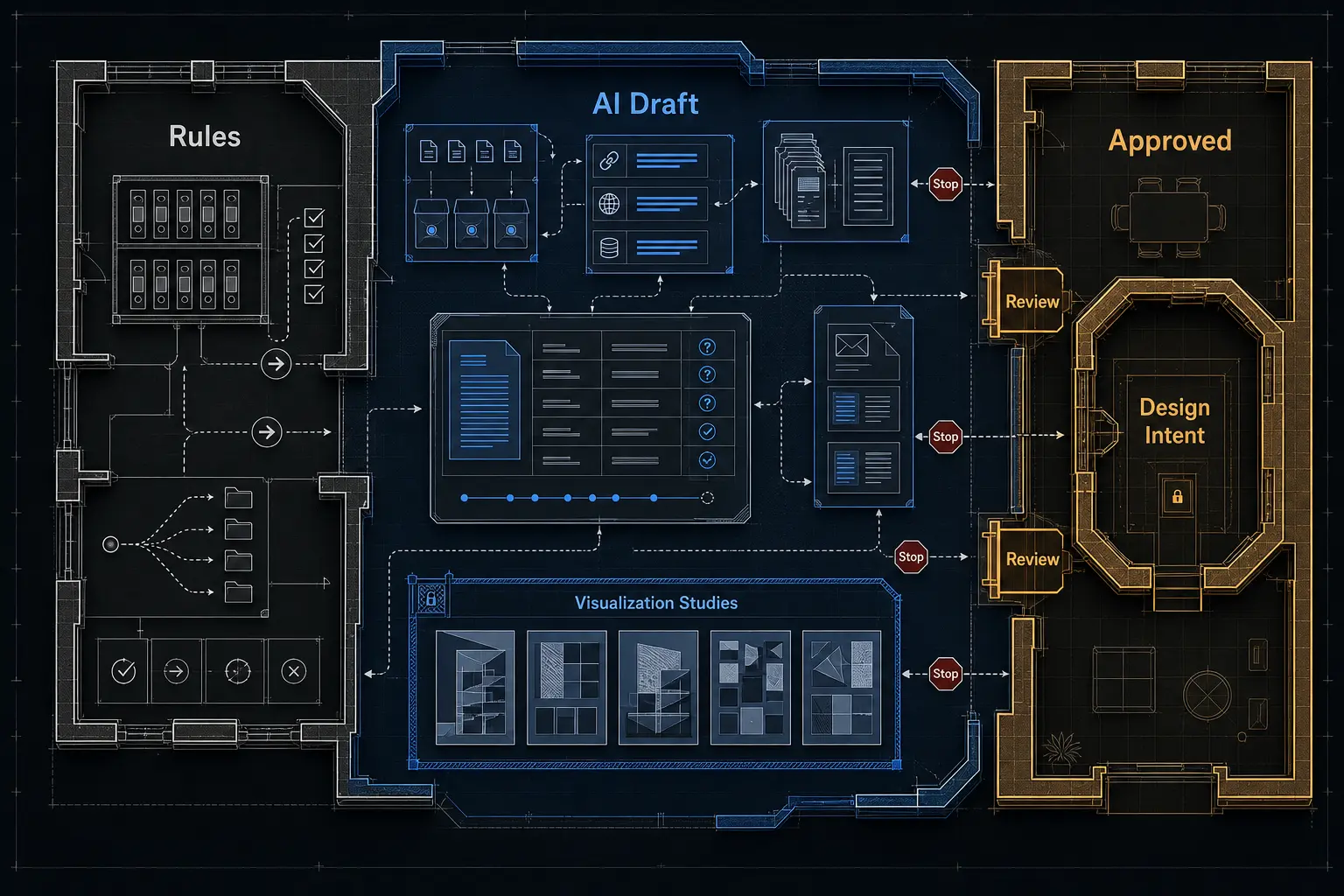
A practical starting point for AI for architecture firms is bounded, repetitive information and production workflows—not unrestricted generation of designs or images. Speed has little value if a system loses project context, invents a deadline, changes design intent, or obscures who approved a decision. Useful adoption begins by matching the mechanism to the task and preserving accountability where the consequences matter.
Architecture practices contain recurring handoffs, fragmented project information, research tasks, communication loops, documentation checks, and visualization production steps. These activities do not carry the same ambiguity or risk. A workable strategy maps each process, separates predictable operations from interpretive work, and places human review at specific decision points. That makes it possible to choose a suitable first workflow, understand its technical structure, and define what the system must never do on its own.
Table of Contents
- AI for Architecture Firms Is More Than Image Generation
- Where AI and Automation Create Value in an Architecture Practice
- How to Choose the Right Architecture Workflow to Automate
- How Reliable AI Architecture Workflows Are Built
- Where AI Automation Should Stop or Require Review
- FAQ
- What to Do Next?
AI for Architecture Firms Is More Than Image Generation
AI for architects is often discussed as though it means generating a design, rendering, or block of text. At practice level, the more useful definition is broader: selective model use combined with workflow automation, structured information handling, explicit business rules, and human decisions. Architecture business automation can create operational value without generating architecture at all. The appropriate mechanism is the simplest one that handles the actual task reliably; fixed rules are not a lesser form of sophistication.
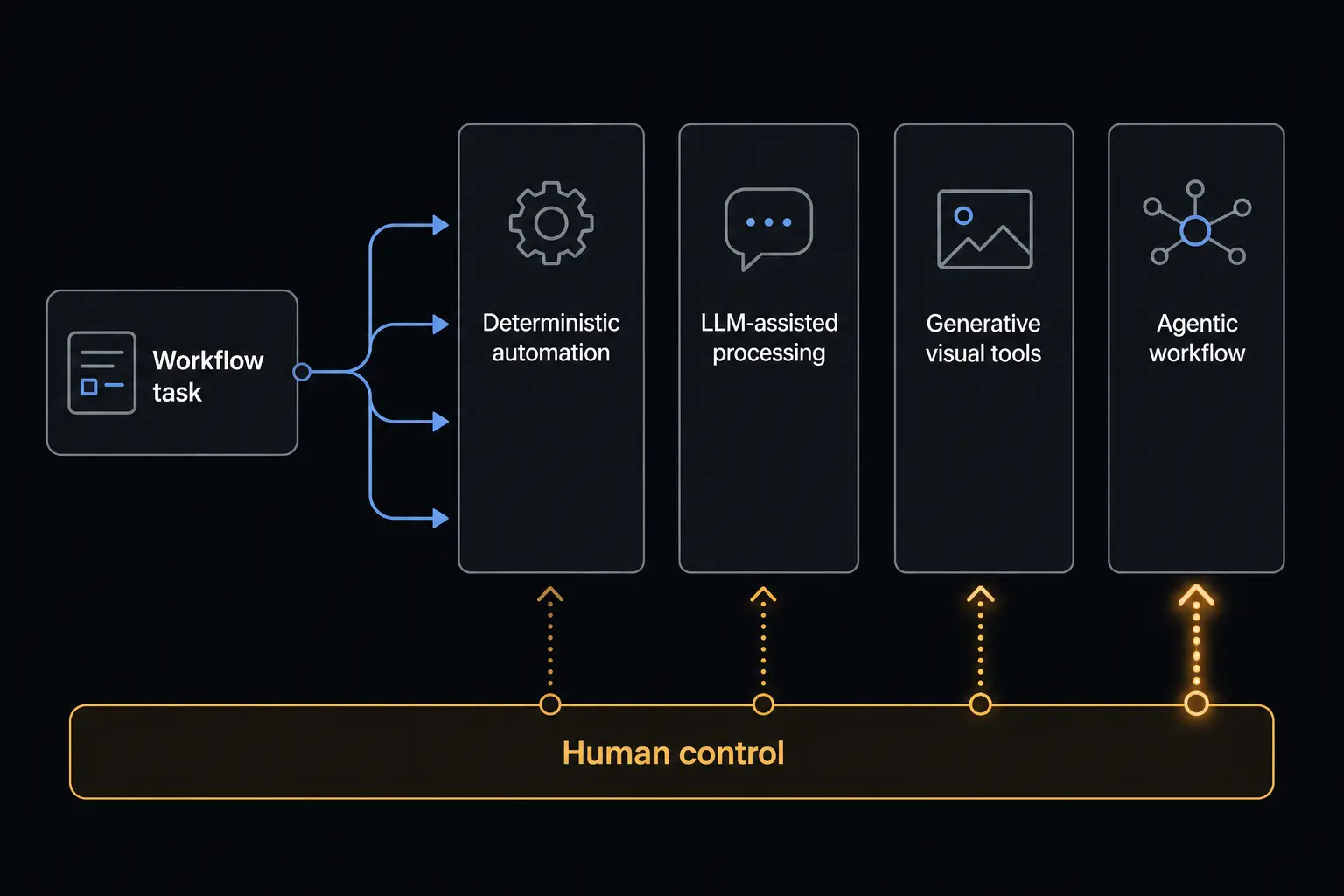
Four mechanisms are worth separating. Deterministic automation follows fixed logic. It is appropriate for operations such as naming files, routing approved exports, creating standard project records, sending notifications, and changing a status after an explicit approval. The same valid input should produce the same prescribed behavior, which makes these operations relatively straightforward to test.
LLM-assisted processing is suited to language tasks such as classification, summarization, drafting, and extracting candidate information from unstructured records. A model might identify proposed actions in coordination notes, but its interpretation is probabilistic. Constraints, source retention, structured output, and review are still needed wherever the result could affect project status or responsibility.
Generative visual tools occupy another category. They can support reference exploration, atmosphere studies, early composition ideas, or visual variation. A compelling image does not inherently preserve model geometry, façade proportions, openings, materials, camera continuity, or design correctness. It can be useful as an exploratory artifact while remaining unsuitable as a controlled representation of an approved design.
An agentic workflow is narrower than ordinary AI-assisted automation. It can choose between actions or tools within defined boundaries, rather than simply executing a fixed sequence containing a model call. Giving a system authority to inspect several records and update multiple platforms introduces decisions, permissions, state, and recovery requirements. Most firms do not need that architecture for every task.
Where AI and Automation Create Value in an Architecture Practice
A useful opportunity map groups work by outcome rather than software category. A workflow might move information, interpret information, create a draft, check a defined condition, or support exploration. This framing reveals where architecture workflow automation improves a handoff and where it merely produces another output that someone must reconcile.
- Operations: route intake, prepare recurring administrative records, standardize project setup, issue reminders, assemble resource requests, and check whether required handoff steps occurred.
- Project information: classify correspondence, extract proposed actions, connect candidate records to their sources, maintain issue registers, and flag incomplete metadata.
- Research: collect source material, organize precedent or product information, compare stated criteria, and prepare drafts that retain references to underlying evidence.
- Documentation support: check naming conventions, find missing fields, compare structured schedules, prepare review lists, and route exceptions to the responsible person.
- Communication: draft status summaries from approved records, adapt the same verified information for different audiences, and assemble review packages without detaching claims from their sources.
- Visualization: organize references, develop controlled variation studies, automate repetitive scene or output management, assist post-production, and prepare labeled material for review.
These applications have different evidentiary limits. A rule can confirm that a drawing identifier follows a defined pattern; it cannot confirm that the drawing communicates the correct design. A model can organize product research; it does not make the selected information current, applicable, or authoritative. Documentation support therefore means preparing and checking defined conditions, not replacing professional verification.
Consider one project-review stage. An approved review record can trigger deterministic filing. An LLM can draft an action summary from its text. A responsible reviewer can confirm which statements are decisions, assign owners, and resolve ambiguous dates. A visualization process can then prepare labeled variants for the next review. Each component changes a distinct handoff, and none should silently turn an uncertain comment into an approved design change.
The recurring value of AI automation in architecture firms is often reduced reconstruction of context. Information arrives once, stays connected to its source, and moves through defined review states rather than being repeatedly copied from emails, notes, registers, models, and presentation packages. That is more operationally useful than making an isolated draft faster while leaving the surrounding handoffs unresolved.
How to Choose the Right Architecture Workflow to Automate
Start with a specific process, not a general ambition to adopt AI. Map its trigger, authoritative inputs, repeated actions, decisions, output, recipient, connected systems, and common exceptions. Then evaluate architecture workflow automation against six conditions: repetition, input quality, decision ambiguity, consequence of error, reversibility, and reviewability.
A strong first workflow recurs often enough to justify maintenance, begins with identifiable source records, produces a bounded output, exposes uncertainty, and already has a natural review point. Stable actions should be testable with rules. Interpretation can be assisted when evidence remains visible. Decisions affecting design intent, project commitments, or professional responsibility should stay under accountable human control.
Exception frequency matters as much as the happy path. A process does not become automatable merely because its ordinary cases look simple. If records regularly omit project identifiers, combine several decisions, use conditional language, or arrive through inconsistent channels, the workflow needs explicit clarification and exception routes. Forced completion turns missing context into fabricated certainty.
Illustrative example: A firm is evaluating whether coordination notes can become draft project action records. The only supplied source says: “Client prefers option B for the lobby ceiling. Update the reflected ceiling plan before Friday’s coordination call. Maya may confirm fixture spacing; structural impact was not discussed.” The project and meeting identifiers are known. The calendar date of Friday, the drawing-update owner, structural implications, and formal approval status are not.
A deterministic step stores the passage with its known identifiers. LLM-assisted extraction proposes a preference of “option B for the lobby ceiling,” an action to “update reflected ceiling plan,” timing of “before Friday’s coordination call,” Maya as a possible fixture-spacing dependency, and “structural impact not discussed” as an unresolved issue. The proposed record retains the source passage.
Explicit rules prevent the workflow from converting “Friday” into a calendar date without calendar context and from assigning Maya as the action owner. Those rules enforce limited conditions; they do not prove the model interpreted the note correctly. An authorized project reviewer must determine whether the preference is a confirmed decision, assign the drawing-update owner, confirm the date, and decide whether structural coordination becomes a separate issue. Only approved fields can enter the live register.
The concrete result is therefore a draft containing the extracted action, unresolved owner, unconfirmed deadline, possible fixture-spacing dependency, structural-coordination flag, and verbatim source—not an altered drawing or completed design decision. If the source instead says, “Explore option B, but retain option A until cost review,” the choice must remain unresolved and be routed for review. The acceptance check is observable: every populated value traces to the source, inferred details remain unconfirmed, no owner or date has been invented, and no live record changes before authorization.
How Reliable AI Architecture Workflows Are Built
Reliable AI architecture workflows are systems, not prompts. The first design decision is the boundary: which event starts the process, which record is authoritative, what transformation is permitted, and which downstream destination may receive the result. Without that boundary, even a good extraction can enter the wrong project, duplicate an existing record, or trigger an action it was never meant to authorize.
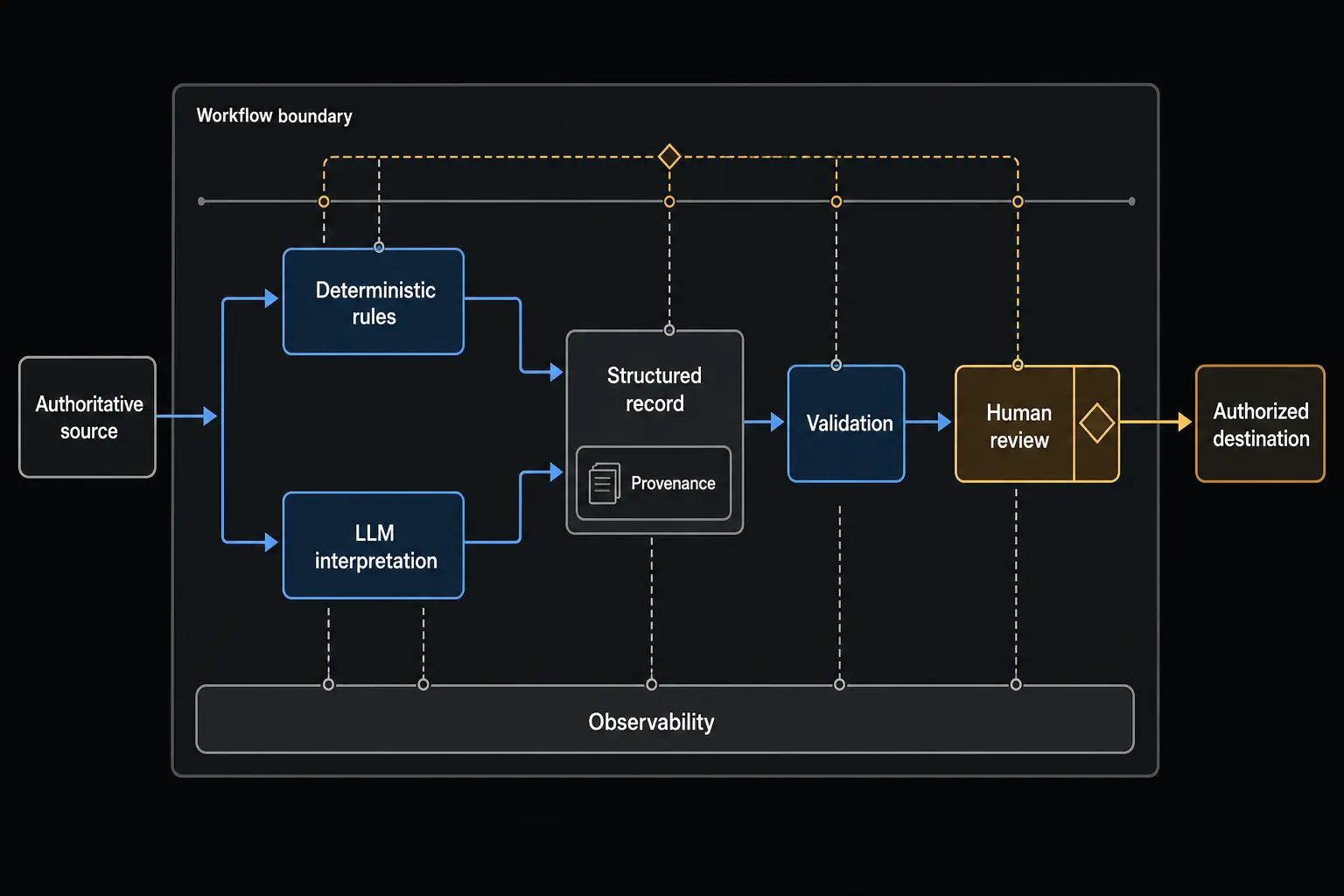
Fixed business logic should remain separate from probabilistic interpretation. Routing, permissions, required fields, allowed statuses, approval gates, and authorized destinations are generally explicit rules. A model can propose a classification or extracted value, but it should not quietly redefine the available statuses or decide that uncertainty equals approval.
Information entering another system should use a structured record. Depending on the task, that record may include required fields, allowed states, source passages, uncertainty labels, validation errors, and approval state. Structural validation can establish that a required field exists or that a status belongs to an allowed set. It cannot establish that the source supports the populated value. That semantic decision requires source comparison, an appropriately limited deterministic check, or qualified human review. Approval of a record authorizes its defined downstream use; it does not mean an open issue described by that record has been resolved.
Provenance makes that review possible. The reviewer should see enough original context to understand where each proposed value came from, rather than receiving a polished summary detached from evidence. The interface or review package should also make the reviewer’s decision concrete: which fields can be edited, what approval means, and exactly which downstream action it permits.
Production architecture workflow automation also needs operational controls:
- Least-necessary permissions, so a drafting process cannot alter drawings, issue documents, or contact external parties.
- Duplicate protection and stable identifiers to prevent repeated triggers from creating repeated records.
- Retries for transient technical failures without repeating irreversible actions.
- Exception routing for missing identifiers, conflicting statements, invalid values, or unavailable destinations.
- A recoverable history showing the input, transformation, validation outcome, reviewer action, destination, and errors.
This visibility is observability in practical terms: someone responsible for the workflow can see what happened and recover when it failed. Logging does not justify collecting unrestricted project information, however. Access, retention, confidentiality, and review procedures must fit the firm’s obligations and the sensitivity of the source material.
A prototype can show that a path may work under selected conditions. A production workflow also has an owner, test cases, access controls, failure behavior, and a maintenance plan for changing templates, source formats, integrations, and model behavior. An agentic layer is generally most appropriate when bounded tool selection or multi-step decisions create enough value to justify added unpredictability, permission risk, and debugging complexity.
Where AI Automation Should Stop or Require Review
The boundary should follow consequence, not novelty. Formatting a draft is different from approving a design decision. Preparing a review list is different from confirming compliance. Stronger controls are necessary when an output can affect safety, contractual communication, regulatory claims, project instructions, issued documentation, or confidential information.
Code, standards, and product research can be assisted through collection, comparison, and drafting. Any consequential claim still needs connection to an authoritative, current source and verification against the applicable jurisdiction and project conditions. A fluent synthesis is not evidence that the correct edition, exception, assembly, or product condition was considered.
Ambiguity is a stop condition when the source does not establish decision status, responsibility, deadline, revision intent, or applicable context. Appropriate failure behavior is not to guess gracefully. The workflow should reject an invalid record, retain it as a draft, flag the discrepancy, request clarification, or stop before downstream action.
Architectural visualization provides a particularly clear boundary. AI-assisted generation can produce exploratory façade mood variants from a controlled reference, provided the images are labeled as studies and reviewed for what changed. This can support discussion of atmosphere, palette, broad material character, or compositional direction without claiming exact representation.
A client-review image intended to communicate an approved façade requires a different production method. Geometry, opening positions, proportions, camera, material assignments, context, and revision state need to remain controlled. Post-production must be checked against the design rather than judged only by visual appeal. A plausible image is especially risky because coherent lighting and detail can conceal architectural changes that would be obvious in drawings or a stable 3D scene.
This distinction is central to responsible AI for architects: speed, plausibility, consistency, and design fidelity are separate measures. Human review must identify the actual decision being protected—such as façade configuration, issue status, compliance interpretation, or authorization to transmit—not merely add an unspecified person “in the loop.”
Some processes should remain manual. Common reasons include exceptions dominating the work, authoritative inputs being inaccessible, review occurring too late to prevent harm, or subtle errors carrying more consequence than the automation is worth. Manual work is not automatically accurate, but automation should not be used where its operating boundary cannot be made explicit and enforceable.
FAQ
Should an architecture firm build or buy its first AI workflow?
An existing product may suit a standardized task if its data handling, integrations, permissions, output structure, and review controls meet the mapped requirements. A custom workflow may be justified when the process crosses firm-specific systems or needs specialized validation, but it introduces maintenance and governance responsibilities. A hybrid can retain existing software for core functions while using a limited integration layer for routing or validation. Map the workflow and define acceptance criteria before making the procurement decision.
What to Do Next?
Choose one recurring process with a clear beginning and end, such as project-information intake, draft action-record preparation, research organization, visualization-output handling, or documentation review support. Create a one-page map showing its trigger, authoritative inputs, repeated actions, decisions, output, recipient, systems, and common exceptions.
Mark every step as rule-based, interpretive, or human-led. Define what the system may propose, what it may execute, and what requires approval. Then test the proposed boundary against representative ordinary and ambiguous source records. Before selecting technology, write down one acceptable result, one unacceptable result, and the required failure behavior when information is incomplete or conflicting.
Decide where human review belongs
Learn how to match review methods to AI-assisted decisions based on consequence, uncertainty, reversibility, and accountability.
After identifying safe workflow boundaries, this next step helps assign proportionate review to each decision point.
Read the article