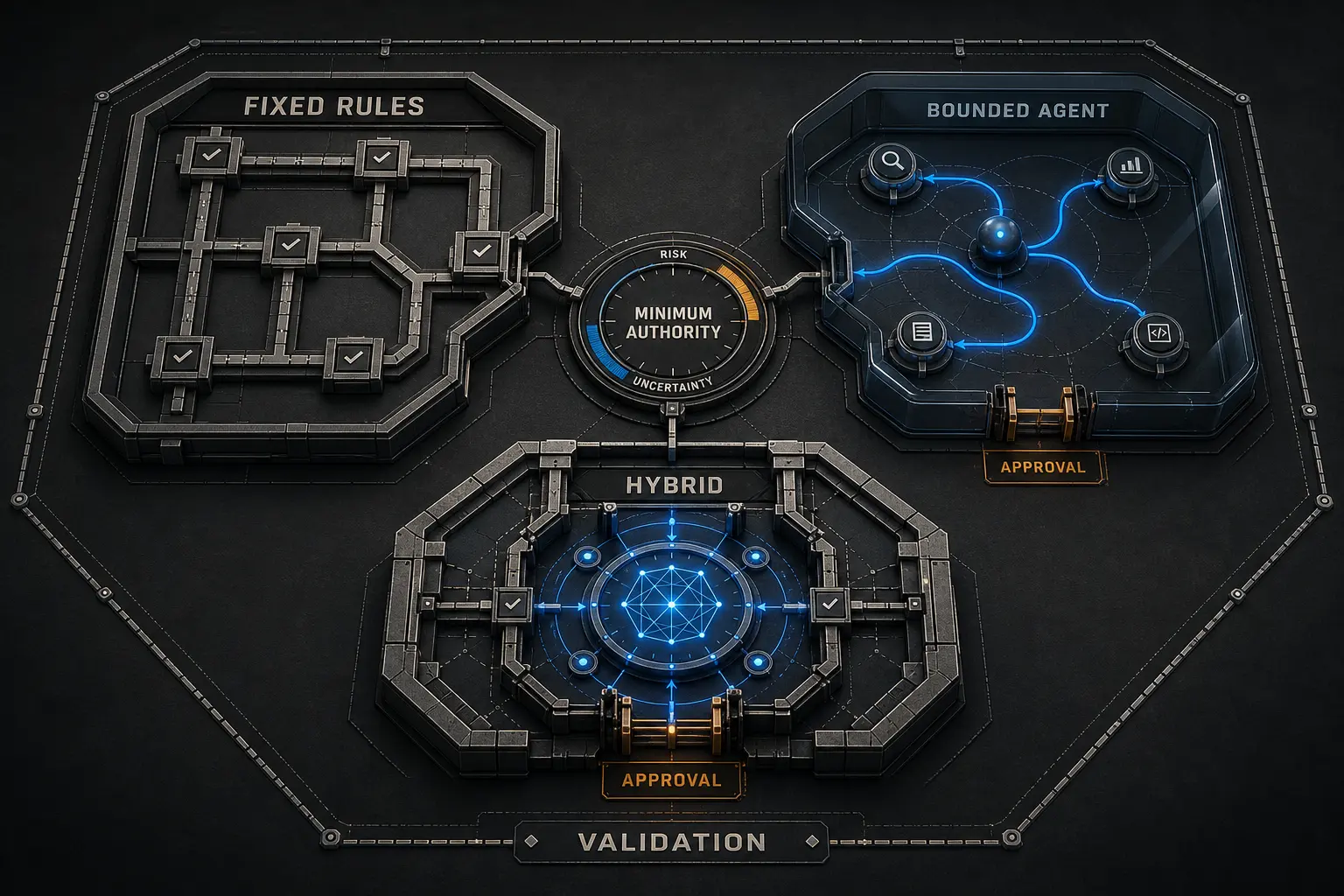
An AI agent workflow is a process in which a model has bounded authority to make decisions, select or sequence tools, and adapt its next action using context or intermediate results. Many systems described as agents are conventional automations containing one or more LLM calls. The distinction matters because increased autonomy typically affects reliability, cost, testing requirements, permissions, and operational control.
The design problem is to identify which steps are fixed, which require interpretation, what actions the system may take, what must be validated, and where a person should approve or resolve an exception. Architecture should follow those boundaries rather than a preference for agents. The framework below covers architecture selection, tool use, state, memory, approvals, orchestration, testing, and failure recovery.
Table of Contents
- What an AI Agent Workflow Actually Is
- Choose an Agent, Automation, or Hybrid Architecture
- The Anatomy of an Agentic Workflow
- Set Decision Boundaries and Human Approval Gates
- Design for Failure Handling and Observability
- Design and Test the Workflow Before Expanding Autonomy
- FAQ
- What to Do Next?
What an AI Agent Workflow Actually Is
A deterministic automation follows a predefined sequence of triggers, conditions, transformations, and actions. A webhook might receive a form submission, validation logic might check required fields, and business rules might route the request to a queue. The route can branch, but every permitted path is defined in advance.
An LLM-assisted workflow introduces model inference into that controlled sequence. The model might classify an unstructured message, extract fields into a schema, summarize a document, or draft a response. Fixed workflow logic then validates the output and determines what happens next. The model performs a bounded task but does not control the overall path.
A genuinely agentic workflow gives the model limited discretion over intermediate decisions. It may select an approved tool, choose the next step, request missing information, or revise its path after receiving a result. That decision authority, rather than the presence of an LLM or API, makes the workflow meaningfully agentic.
Tool use alone is insufficient. If orchestration always calls a search API, sends the result to a model, and writes a record, the sequence remains deterministic. The model may produce variable content, but it does not decide whether to search, which permitted source to use, or what evidence is still needed.
Consider three versions of an incoming service-request process. The first routes requests using form fields and fixed rules. The second uses a model to classify the message before fixed routing takes over. The third allows an agent to inspect the request, retrieve relevant policy material, identify missing details, and propose a resolution path. These represent increasing decision authority, not an automatic progression in quality.
Agentic automation is therefore a spectrum. A capable model can operate within a narrow process, while a less constrained model may still produce an unreliable system. Many effective AI agent workflows use a hybrid architecture: a probabilistic center for interpretation or selection, surrounded by a deterministic shell that controls permissions, validation, execution, and record keeping.
Choose an Agent, Automation, or Hybrid Architecture
The architecture should reflect the structure and consequences of the process. Five criteria provide a useful first test: variability, rule clarity, action risk, reversibility, and validation. Context requirements and exception frequency refine the decision.
- Use deterministic automation when the path is stable, rules are explicit, inputs can be normalized, and outputs can be checked directly.
- Use bounded agentic behavior when unfamiliar inputs require interpretation, tool selection, or an adaptive sequence that would be impractical to encode as fixed branches.
- Use a hybrid architecture when interpretation is probabilistic but execution, permissions, validation, and system updates require predictable control.
Variability asks whether the process follows a small set of known paths or changes substantially with each request. Rule clarity asks whether decisions can be represented reliably through conditions, schemas, lookup tables, or business logic. Stable paths and explicit rules usually favor conventional automation because it is easier to test, debug, and maintain.
Action risk can change the answer even when an agent would be useful. Selecting an internal knowledge source is different from issuing a refund, deleting data, or changing a contractual record. Reversibility matters for the same reason: a draft can be discarded, while an external commitment may be difficult to retract. Validation asks whether another mechanism can prove that an action is permissible and correctly formed before execution.
In a request-resolution workflow, deterministic steps can capture the request, validate identifiers, and retrieve the relevant account. An agent can interpret an ambiguous description and propose a route. Fixed logic can then execute a low-risk, reversible action that passes validation or create an approval task for a consequential action.
Exception frequency also matters. Rare exceptions can be routed to a person without making the normal path agentic. If interpretation and exception handling are the core of the work, bounded autonomy becomes more defensible. Even then, ambiguity does not justify unrestricted action. AI agents for business are useful when their authority matches operational risk, not when they imitate broad human access.
The Anatomy of an Agentic Workflow
A production-oriented agentic workflow begins with a trigger: a webhook, scheduled event, message, record change, or direct request. The trigger supplies the initial input and should establish enough identity and context to create a traceable workflow run.
An orchestrator manages execution around the model. It prepares context, exposes permitted tools, tracks state, enforces iteration limits, validates structured outputs, handles retries, and controls transitions. The model is a reasoning and selection component within this system, not the entire system. Authentication, permissions, validation, and audit records belong outside model judgment.
Tools are constrained interfaces to APIs, databases, retrieval systems, messaging services, or internal functions. Each should have a specific purpose, defined input schema, and predictable output shape. The orchestrator should reject malformed parameters before execution and validate returned data before passing it onward. Broad database access or generic code execution creates a much larger risk surface than narrowly scoped functions.
State and memory are related but distinct. Workflow state records what is true about the current run: its request identifier, completed steps, retrieved evidence, current status, proposed action, and approval outcome. Short-term context is the information supplied to the model for its next decision. Persistent memory retains selected information beyond the current run for later retrieval.
Persistent memory is optional. Add it only when a later decision genuinely depends on retained information that cannot be retrieved safely from an authoritative system. Unnecessary memory creates privacy, staleness, relevance, retrieval, and maintenance problems. A database of workflow records becomes agent memory only when selected records are deliberately retrieved to influence later model decisions.
In the request-resolution example, a webhook receives the case and fixed validation checks required fields. The orchestrator creates state, then allows the model to select from approved retrieval and classification tools. Structured results are checked, the proposed action is recorded, and the workflow proceeds to execution or approval. A completion rule, maximum iteration count, and time limit prevent uncontrolled loops.
Set Decision Boundaries and Human Approval Gates
A decision boundary states what the agent may decide and what remains outside its authority. Useful boundaries cover action type, data scope, operational or monetary impact, required evidence, reversibility, and the conditions that return control to deterministic logic or a person.
Separate proposing an action from executing it. An agent might classify a request, retrieve supporting policy, and draft a recommended response without permission to send that response or alter the system of record. This preserves the value of model judgment while limiting the consequences of an incorrect decision.
Tool access should be allowlisted and follow least-privilege principles. A retrieval tool may read only approved sources. An update tool may expose a narrow set of fields rather than unrestricted database access. Explicit parameter schemas should constrain identifiers, action types, and allowable values. Asking a model to remember a policy is not an access-control mechanism.
Human approval is appropriate for irreversible, legally sensitive, security-sensitive, financially consequential, or unusually ambiguous actions. Approval should be a defined workflow state with an owner, timeout, and escalation path. The reviewer needs the original request, relevant evidence, proposed action, validation results, and a clear description of what the system intends to change.
Model confidence is not proof. A confidence score may help prioritize review after task-specific testing, but it should not independently authorize a consequential action. Stronger authorization comes from verifiable conditions: required evidence exists, records agree, parameters pass validation, permissions allow the action, and the operation remains within a tested scope.
Escalation conditions should include missing data, contradictory evidence, repeated tool failures, unsupported requests, and attempts to use prohibited actions. The audit trail should preserve relevant inputs, tool calls, validated outputs, state transitions, approval decisions, and the final action. Human review is not evidence that AI agent automation failed; it is part of the design.
Design for Failure Handling and Observability
Agentic systems fail at different layers, each requiring a different response. Model failures include malformed structured output, unsupported conclusions, poor tool selection, and repeated loops. Tool failures include timeouts, rate limits, unavailable APIs, and invalid parameters. Data failures include missing fields, stale context, conflicting records, and unexpected formats.
Orchestration can fail by losing state, taking an invalid transition, duplicating execution, or ending before completion. Permission failures occur when credentials expire or an action exceeds the allowed scope. Business-rule failures happen when a technically valid action violates policy. Prompt changes cannot repair infrastructure, data, permission, or state-management defects.
Retry behavior should match the failure. A temporary network timeout may justify a limited retry with backoff. Invalid tool parameters should return to validation or controlled correction. An unsafe action should not be retried. If an evidence tool remains unavailable, the workflow should preserve its state and move to deferred processing or human review rather than proceed with incomplete information.
Repeated execution also needs duplicate-prevention controls. An idempotency key or equivalent mechanism can prevent a retry from creating a second record, sending a duplicate message, or applying the same update twice. This is critical when the system loses confirmation after an external action has already succeeded.
In production, each run should have limits such as maximum tool calls, iterations, execution time, and an appropriate resource or cost boundary. Observability should capture tool selection, validated inputs and outputs, state transitions, retries, exceptions, approval outcomes, and completion status. Operators need visible failure states and enough context to resume, retry, cancel, or reassign a case.
Output quality monitoring and system reliability monitoring are different. A response can be fluent but unsupported, while a correct proposed action can still fail during execution. Agentic automation requires both forms of evaluation. Maintenance also extends beyond prompts because tools, schemas, credentials, policies, and external dependencies change.
Design and Test the Workflow Before Expanding Autonomy
Start with the process, not the model. Map the trigger, required inputs, expected outputs, systems touched, completion condition, and responsible human roles. Mark each step as deterministic, interpretive, action-taking, validation, approval, or exception handling. This often reveals a smaller agentic boundary than the original concept implied.
Identify the narrowest point where model judgment provides genuine value. A request-resolution process might begin with fixed validation and a model-assisted recommendation. If some cases require adaptive retrieval, the next version can allow a bounded agent to choose among approved information tools. Execution authority is a separate decision and should not arrive automatically with tool-selection authority.
Before implementation, define tool contracts, output schemas, state transitions, stopping conditions, prohibited actions, and escalation rules. Test normal requests, missing information, conflicting records, irrelevant or adversarial input, tool outages, repeated actions, invalid outputs, and requests outside the supported scope.
Evaluate more than whether generated text sounds plausible. AI agent workflows are often usefully assessed for task correctness, tool-selection correctness, policy compliance, validation performance, recovery behavior, reviewer burden, duplicate prevention, and end-to-end completion. A workflow that writes an excellent recommendation but regularly stalls before recording its final state is not operationally reliable.
Compare the agentic version with a deterministic or LLM-assisted baseline. The question is whether adaptability justifies the additional latency, variability, testing effort, monitoring, and maintenance. A hybrid architecture often performs well in this comparison because it places probabilistic judgment where fixed rules are weak while preserving reliable process control elsewhere.
Expand autonomy only after observing behavior within the current boundary. Low-risk, reversible actions that pass deterministic checks are reasonable early candidates. Broad tool access, multi-agent coordination, and irreversible execution require specific evidence that simpler designs cannot meet the workflow’s needs. Some processes should remain deterministic, and some should remain human-led.
FAQ
Does tool use make a workflow agentic?
No. Tool access becomes agentic when the model has bounded discretion to select tools, sequence steps, or change its path using intermediate results. A fixed chain of model calls and API requests remains an orchestrated automation, regardless of how many tools it uses.
How much memory does an AI agent need?
Use the minimum required by the task. Current-run state tracks execution, short-term context supports the next decision, and persistent memory carries selected information across runs. Retaining unnecessary data introduces privacy, staleness, retrieval, relevance, and maintenance risks.
Should a workflow use one agent or multiple agents?
Prefer one bounded agent unless separate roles genuinely require different tools, context, permissions, or validation. Multiple agents introduce coordination, latency, state-management, debugging, and failure-attribution problems. Role names alone do not justify separate agents.
Can an AI agent act without human approval?
Yes, within a tested boundary where actions are low-risk, reversible, permissioned, and independently validated. Consequential, irreversible, security-sensitive, or ambiguous actions should generally remain proposals until a responsible person approves them.
How do you know whether an agentic workflow is better than automation?
Compare it with a simpler baseline. Evaluate successful completion, correct tool selection, policy compliance, exception handling, recovery, execution consistency, reviewer effort, resource use, and maintenance burden. Fluent output alone does not demonstrate that the agentic design is better.
What to Do Next?
Choose one specific process rather than beginning with a general desire to deploy an agent. Write down its trigger, inputs, expected output, systems involved, completion condition, and exceptions. Mark each decision as rule-based or judgment-based, then identify whether the uncertain step requires classification, generation, tool selection, or adaptive planning.
- Keep stable rules and directly verifiable actions deterministic.
- Define the smallest useful agentic boundary.
- List allowed tools, prohibited actions, schemas, and validation checks.
- Specify approval, escalation, stopping, and recovery conditions.
- Test a deterministic or model-assisted baseline against the bounded agentic version.
- Expand authority only where observed results justify the additional complexity.
The appropriate result may be deterministic automation, one bounded LLM task, a hybrid system, or a decision not to automate. Architecture should follow the process and its risks, not the label attached to the technology.