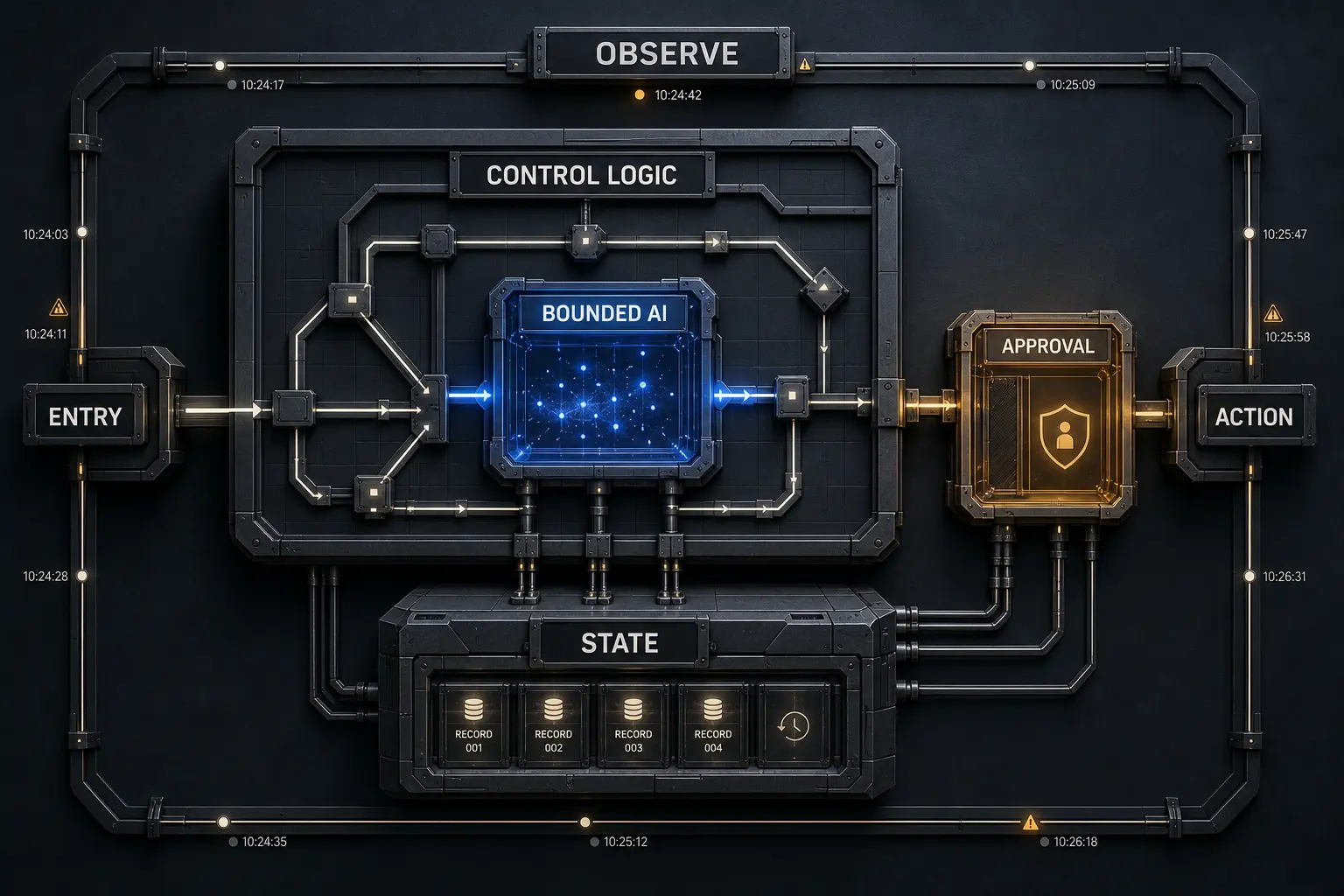
n8n AI automation can coordinate models, APIs, databases, business applications, deterministic rules, and human review within one workflow. The difficult part is not connecting an LLM. It is designing predictable behavior around a probabilistic component: controlling its inputs, validating its outputs, preserving state, limiting its authority, and recovering safely when the model or another dependency fails.
A production design therefore needs clear decisions about which steps belong to fixed logic, which benefit from a direct model call, when an agent is justified, and where a person must approve the result. It also needs explicit data contracts, exception paths, durable records, duplicate protection, and operational ownership. These boundaries determine whether an AI-enabled workflow remains a useful prototype or becomes a dependable business process.
Table of Contents
- What n8n AI Automation Actually Orchestrates
- Choosing Between Rules, Models, Agents, and People
- A Production Architecture for n8n AI Workflows
- Designing a Controlled AI Workflow Step by Step
- Reliability, Error Handling, and Observability
- Evaluating n8n for Production Automation
- FAQ
- What to Do Next?
What n8n AI Automation Actually Orchestrates
n8n AI automation is workflow orchestration with AI added at specific interpretation or decision points. A trigger starts an execution, data moves between components, rules determine known branches, external services perform specialized operations, and persistent systems retain important state. The model is one dependency within that arrangement. It does not replace the database, business application, access-control policy, or workflow logic.
A typical execution path begins with an event such as a webhook, schedule, or application update. The workflow verifies the event source where required and normalizes the payload into a stable internal shape. It then performs lookups, calculations, model calls, or other operations. Outputs are validated, relevant state is updated, and the result is routed to another application, an approval path, or an exception queue.
Consider a hypothetical inbound service-request process. A webhook receives the request, deterministic checks confirm that required fields exist, and an LLM classifies the request while extracting structured details. A database lookup adds account context. Business rules select the permitted route, while uncertain or sensitive requests go to a person before any consequential update occurs.
That differs from conventional n8n automation only where AI genuinely helps. Fixed transformations, schema checks, calculations, and known routing tables do not become better merely because a model performs them. Models are useful for interpreting ambiguous language, classifying free-form requests, extracting information, or drafting text.
Production quality depends at least as much on the workflow around the model as on the prompt. Every external dependency introduces its own authentication, latency, availability, rate-limit, and data-quality constraints. Connecting those dependencies proves that data can move. It does not prove that the resulting system is safe, recoverable, or operationally valid.
Choosing Between Rules, Models, Agents, and People
The safest design uses the least complex mechanism that can perform each task. Four questions help allocate responsibility: How predictable is the task? How variable is the path? What is the consequence of an error? Can the action be reversed?
- Use deterministic logic when inputs, rules, and outputs can be specified directly. Examples include required-field checks, calculations, routing tables, permission checks, and record updates.
- Use a direct LLM call for a bounded probabilistic task with a defined input and output contract, such as classification or structured extraction.
- Use a bounded agent when the appropriate next action depends on context and cannot be fully sequenced in advance.
- Use human review when errors could create material financial, legal, operational, reputational, or customer-facing consequences.
n8n AI agents should not be treated as a synonym for workflows containing models. An agent has meaningful delegated discretion: it can select among approved tools or actions, inspect intermediate results, and choose what to do next within defined limits. Tool use alone does not make a workflow agentic. If three API calls always occur in a known order, deterministic orchestration will usually be easier to test and debug.
In the service-request example, an exact known category might be handled by a rule. Ambiguous language can go through an LLM classifier. A bounded agent could be justified if different requests require different account lookups and the correct lookup cannot be known until earlier evidence is examined. Even then, its available tools, permissions, action count, and stopping conditions should be restricted.
A consequential action such as account cancellation belongs behind approval unless the policy, evidence, and reversibility justify full automation. A well-designed n8n AI agent workflow is therefore often hybrid: rules prepare the input, a model interprets it, an agent performs limited context gathering, deterministic checks validate the proposal, and a person authorizes the final action.
A Production Architecture for n8n AI Workflows
Production-oriented n8n AI workflows are easier to reason about when organized by responsibility rather than node sequence. The exact implementation varies, but eight functional layers provide a useful architecture.
- Entry receives triggers, schedules, webhooks, or application events.
- Normalization verifies the source where required, validates fields, converts types, detects duplicates, and creates a stable data object.
- Orchestration handles sequencing, branching, loops, subworkflows, dependencies, and business rules.
- Intelligence contains direct model calls or bounded agents with only the context and tools required for their task.
- State preserves durable records, statuses, prior decisions, approval state, and idempotency references.
- Action controls external writes, notifications, API requests, and downstream operations.
- Control validates outputs, applies permissions, handles uncertainty, and routes approval or rejection.
- Observation records execution references, failures, decision traces, timestamps, and alerts.
In the example, the webhook is the entry layer. Normalization creates a consistent request object. The intelligence layer classifies it, while the orchestration layer coordinates an account lookup and applies routing policy. A durable case record stores status and approval state. The action layer updates the destination application only after validation, and the observation layer associates the execution with a case identifier.
The separation between execution data and durable business state is especially important. Workflow execution history should not automatically become the system of record. A case that must survive interrupted executions, approval delays, retries, or workflow revisions needs an authoritative persistent record selected for those requirements.
Likewise, n8n workflow automation should limit credentials and sensitive context to the operations that need them. A classification task may require the request text but not a full account history. An action step may need write credentials but not the original prompt. Narrow boundaries reduce accidental exposure and make permissions easier to inspect.
Designing a Controlled AI Workflow Step by Step
Start with the operational outcome, not the model or node selection. Define what starts the workflow, what counts as completion, which system receives the result, and who owns exceptions. Document required fields, trusted data sources, external side effects, and the authoritative source of truth.
Next, draw the happy path and exception paths without AI. For the service-request workflow, the sequence could be:
- Receive the request, verify its source, and check required fields.
- Reject malformed input safely and create a durable case identifier for accepted requests.
- Classify the request into a controlled set of categories.
- Validate the structured result and gather only the required account context.
- Apply routing policy and create a proposed action.
- Pause for approval when sensitivity, uncertainty, or consequence requires it.
- Perform the approved update and record the final status.
Normalize incoming data before later steps consume it. Source payloads change, optional values disappear, and different applications represent the same concept differently. A stable internal object isolates the rest of the workflow from those inconsistencies and creates a clear contract between subworkflows.
For model tasks, constrain both input and output. Specify required fields, accepted categories, and the behavior for missing or invalid results. Structured output makes validation possible, but parseable syntax is not enough. A valid object can still contain an unsupported category, an account identifier that does not match the case, or a proposed action prohibited by policy.
Keep critical business policy outside prompts where possible. Permissions, thresholds, mandatory routing, prohibited actions, and approval requirements should remain explicit deterministic logic. Retrieve only the context needed for the current decision rather than placing every available record into the model request.
Persist state before consequential writes so an interrupted execution can be reconciled. Human review should also be represented as a controlled state transition, not an informal message. Store the proposed action, relevant evidence, reviewer decision, and resulting status. External writes should use duplicate protection where feasible, allowing retries without creating repeated records or actions.
Complex n8n business automation is usually clearer as bounded subworkflows with explicit inputs and outputs. If an optional n8n AI agent workflow gathers context, its output should return to the controlled process for validation and approval rather than bypassing those controls.
Reliability, Error Handling, and Observability
Reliable automation begins by separating failure types. Transport errors, authentication failures, rate limits, timeouts, malformed input, invalid model output, policy rejection, duplicate events, and delayed human review require different responses. Treating all of them as generic execution failures leads to unsafe retries and poor diagnosis.
Temporary network or service failures may justify bounded retries with delay. Invalid credentials require correction. Malformed input should be rejected or routed for repair. A policy violation is a business outcome, not a transport problem. Repeating the same model request after a structurally valid but prohibited answer may simply reproduce the failure.
Retries become dangerous after an external side effect. If a destination write succeeds but its acknowledgement is lost, an immediate retry can create a duplicate. Idempotency keys, operation records, or pre-write checks allow the workflow to determine whether the intended action already occurred.
Model output should be checked for parseability, schema conformity, required fields, allowed values, relevant evidence, and business constraints. Suppose the service-request classifier returns an unsupported category after the account lookup succeeds. The workflow should reject that result before updating the destination application, record the failure against the case, and route it to review rather than retrying indefinitely.
A terminal exception path should retain enough information for recovery: the original input reference, current state, failure category, completed operations, and a safe restart point. Fallback behavior must also be visible. Quietly replacing a failed AI decision with a guessed default hides degraded operation and can produce harder-to-detect errors.
Minimum observability for n8n automation should include an execution identifier, timestamps, workflow version, external request references, validation outcome, approval status, and final action. Model-task metadata can help diagnosis where appropriate, but logging complete prompts and outputs is not always safe. Credentials, personal information, and sensitive business context need deliberate retention and access boundaries.
Maintenance continues after deployment. Recurring exceptions, source-schema drift, dependency changes, revised policies, and workflow-version changes all affect behavior. Observability is useful only if someone owns the alerts and uses the evidence to repair the process.
Evaluating n8n for Production Automation
Evaluate a specific workflow rather than n8n in the abstract. Begin with integration fit: required systems, API access, authentication methods, data formats, and any custom operations. Then assess whether the process can express its business rules, permissions, validation, approval paths, and exception handling clearly.
State requirements deserve a separate review. Identify what must persist, which system is authoritative, and how interrupted executions will be reconciled. Scale should be evaluated against actual event frequency, bursts, payload size, external rate limits, execution duration, and concurrency needs rather than universal thresholds.
Operational ownership is equally important for n8n business automation. Someone must monitor failures, manage credentials, review approval queues, update dependencies, and control changes to workflow logic. A technically valid workflow without an exception owner is generally not production-ready.
Evaluate AI suitability independently from platform suitability. Look at task ambiguity, context sensitivity, acceptable error, validation options, and the consequence of a wrong action. Warning signs include undefined business rules, inaccessible source data, irreversible actions without approval, and using an agent to compensate for a process that has never been specified.
A staged evaluation is safer than building the complete system at once. Create the deterministic skeleton first. Add one bounded AI task, enforce structured validation, test with controlled inputs, implement the approval path, and simulate failures before increasing automation.
For the service-request workflow, verify API access, designate the case database as the source of truth, test duplicate webhook delivery, simulate an unavailable model, reject invalid output, exercise approval and rejection paths, and confirm that a failed destination write can resume safely. The right n8n AI automation design may ultimately contain little AI if most of the process is predictable. That is sound engineering, not a limitation.
FAQ
Is n8n AI automation the same as an AI agent?
No. n8n AI automation is the broader orchestration of rules, services, models, data, and people. An agent is one optional component that can choose among bounded tools or actions when the next step cannot be completely predefined.
When should an n8n workflow use an agent?
Use an agent when context determines which approved tool to use or when a bounded sequence must adapt to intermediate results. A fixed process with known branches is generally clearer, easier to test, and easier to debug as deterministic workflow logic.
How should AI output be validated before an n8n workflow uses it?
Require structured output, then check parseability, schema conformity, required fields, allowed values, and business rules. Route uncertain or consequential results to review. Syntactically valid output is not necessarily semantically or operationally valid.
Where should an n8n AI workflow store state?
Temporary values can remain within an execution, but important status, approval decisions, idempotency references, and recovery information belong in an appropriate durable system. The correct store depends on the workflow’s authority, retention, access, and recovery requirements.
Can n8n AI workflows run without human approval?
Yes, for low-risk, reversible, well-validated actions. Ambiguous, sensitive, high-impact, or irreversible decisions should use approval or escalation. The deciding factors are consequence and recoverability, not whether the workflow is technically able to execute the action.
What to Do Next?
Select one bounded operational process and create a one-page workflow map. Define its trigger, completion condition, inputs, output, source of truth, external side effects, and exception owner. Mark every step as deterministic logic, a direct model call, a bounded agent decision, or a human decision.
Specify the data contract at each boundary, then identify validation, durable state, duplicate protection, retries, logging, fallback, and approval requirements. Build the deterministic skeleton before adding one narrowly defined AI task. Test malformed inputs, unavailable dependencies, invalid model outputs, duplicate events, rejected approvals, and interrupted external writes before allowing consequential actions.