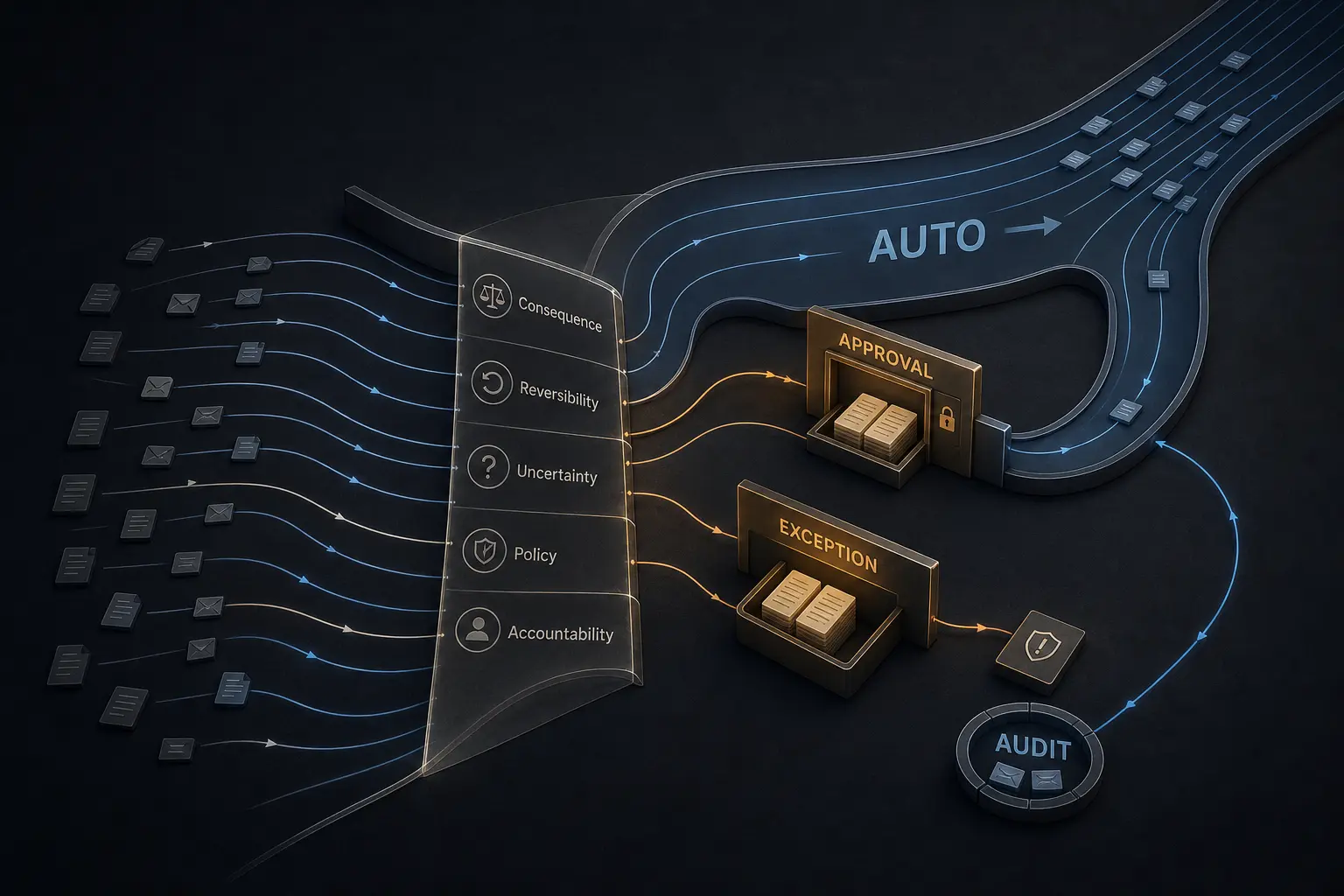
Human in the loop AI is a workflow design in which people intervene at selected decision points rather than supervising every model output. The purpose is not to make all automation wait for approval. It is to identify which outputs or actions justify human judgment because they involve ambiguity, policy exceptions, meaningful consequences, or accountable decisions.
The practical challenge is deciding when a system may proceed automatically, when it should request approval, what evidence a reviewer needs, and what happens if review is delayed or unavailable. A workable design needs risk-based checkpoint placement, explicit routing logic, preserved workflow state, useful reviewer context, and safeguards for rejection, timeout, escalation, and recovery.
Table of Contents
- Human in the Loop AI Is Selective Intervention, Not Constant Supervision
- Where Human Checkpoints Belong in an AI Workflow
- Designing the End-to-End Approval Workflow
- Routing Review, Exceptions, and Escalation
- Designing Human Review That Produces Better Decisions
- Measuring and Maintaining the Oversight System
- FAQ
- What to Do Next?
Human in the Loop AI Is Selective Intervention, Not Constant Supervision
A human-in-the-loop operating model combines automated processing with deliberately placed human decisions. A model might classify an input, extract facts, generate a proposal, or recommend an action. Deterministic workflow logic then validates what software can check reliably and decides whether to continue, pause, or route the case to a person.
Several forms of human involvement are commonly conflated. AI assistance gives a person a generated draft while leaving the decision with them. Pre-action approval prevents a proposed action from executing until someone authorizes it. Exception handling routes only cases that violate rules or lack sufficient information. Retrospective review inspects completed work, while sampled audit examines a subset of otherwise automated outcomes. Fully automated execution proceeds without case-by-case intervention.
Adding a person somewhere in the process does not automatically create meaningful oversight. A reviewer who lacks context, authority, time, or explicit decision criteria may simply approve what the system presents. Human review also does not guarantee correctness. It introduces another decision-maker with limited attention, possible bias, and another opportunity for error.
Effective human in the loop AI automation uses deterministic validation before spending human attention. Required fields, allowed values, duplicate detection, authorization limits, and data-format rules should usually be checked by software. People are more valuable where the decision depends on context, competing evidence, unclear policy, an unusual exception, or acceptance of responsibility.
Human attention is a limited review budget. Every checkpoint adds latency, queue pressure, coordination overhead, and cognitive load. Oversight can occur before an action, during an exception, or after execution through audit. The right pattern depends on what a failure would mean.
Consider a hypothetical service-request process. AI classifies each request and drafts a response. Routine informational replies can proceed after deterministic checks, with a sample reviewed later. An unusual policy exception goes to an authorized process owner. A proposed account change pauses before execution. The presence of an LLM call does not determine the need for review; the consequence and decision boundary do.
Where Human Checkpoints Belong in an AI Workflow
To map a human in the loop workflow, assess each proposed decision or action across five dimensions: consequence, reversibility, uncertainty, policy sensitivity, and accountability. These dimensions are more useful than a blanket rule that every AI-generated output needs approval.
- Consequence: What happens if the output is wrong? A weak internal summary and an incorrect external account action are not equivalent failures.
- Reversibility: Can the result be edited or withdrawn easily, or will it trigger an action that is costly, visible, or difficult to undo?
- Uncertainty: Is important context missing, conflicting, unusual, or outside the conditions the workflow was designed to handle?
- Policy sensitivity: Does the case involve restricted actions, sensitive data, unclear rules, or an exception to normal operating policy?
- Accountability: Must a named person or authorized role explicitly accept responsibility for the decision?
Uncertainty should not be reduced to a model-generated confidence value. Useful signals also include missing source fields, contradictory records, validation failures, unfamiliar input patterns, or disagreement between independent checks. A confidence score is operationally useful only if it has been evaluated for the specific model, task, inputs, and threshold under consideration.
The checkpoint type should follow the risk. A hard approval gate belongs before a consequential or difficult-to-reverse action. Exception review suits ambiguous or policy-sensitive cases. Post-action review can be appropriate for reversible outcomes where immediate execution matters. Sampled audit provides visibility into low-impact automated work without forcing every item through a queue.
In the service-request example, a validated informational response can be sent automatically. A proposed account change requires authorization before execution. An unclear request is routed for interpretation before the system generates either a response or an action. This is AI human oversight tied to operational consequence, not simply to the use of AI.
One well-placed gate before an irreversible action is often stronger than several weak checkpoints earlier in the process. Repeated approvals divide attention and may encourage reviewers to assume that someone else has already checked the important issue. Place the checkpoint where a human decision can still change the outcome.
Designing the End-to-End Approval Workflow
An AI approval workflow is not a notification with two buttons. It is a stateful process that begins before the review request and continues after the decision. Its major stages are the trigger, source input, model task, structured output, deterministic validation, risk classification, proposed action, human disposition, and controlled resumption.
The reviewer should receive a decision-ready artifact rather than an unexplained block of model text. For a service request, that package might contain the request category, relevant extracted facts, proposed response, intended account action, validation status, missing information, and reason for escalation. A structured output makes these fields separately testable and prevents downstream logic from depending on loosely formatted prose.
Reviewer choices should match the real decision. Useful dispositions can include approve, edit and approve, reject, request more information, or escalate. Each choice needs an explicit continuation path. Approval may authorize an action; editing should store the final version; rejection should terminate or redirect the proposal; and escalation should transfer authority without accidentally executing the original branch.
The human AI workflow must preserve state while it waits. That state should identify the original input, proposed output, validation results, intended action, workflow version, and current status. Where appropriate, the audit record should also capture the reviewer’s decision, edits, reason code, role or identity, and timestamp. The system should resume from this stored state rather than rerunning a model call and silently producing a different proposal.
Pending approvals introduce additional failure modes. The source record may change while review is waiting. A reviewer may submit twice, respond after cancellation, or approve an outdated proposal. Safe designs use unique decision identifiers, prevent duplicate execution, and verify that relevant data has not become stale before committing the action. Rejection must also be terminal for the rejected artifact unless a defined revision path creates a new version.
Synchronous approval holds an active interaction while a person decides and suits genuinely immediate, short-lived decisions. Asynchronous approval stores the case in a queue and resumes it later. The latter is usually more realistic when response time is uncertain, but it requires timeout, reassignment, expiration, cancellation, and recovery behavior. No consequential workflow should assume that a reviewer is always available.
Routing Review, Exceptions, and Escalation
Selective routing preserves the value of human in the loop automation. Cases should reach people according to decision type, required authority, subject expertise, sensitivity, urgency, and current workload. Sending every exception to one general queue hides meaningful differences between interpretation, authorization, and technical failure.
Approval and escalation are not interchangeable. An approver authorizes a defined action within an established boundary. An escalation recipient handles a case outside that boundary, perhaps because the policy is unclear, the requested action exceeds an authority limit, or specialist judgment is required. A data-validation failure is different again: it may need operational correction rather than someone judging whether an AI response sounds acceptable.
Use deterministic rules where routing conditions are explicit. An action above an authorization limit, a restricted request category, or a missing required record can be routed without AI interpretation. AI classification is useful when the category itself depends on language or context, but the model should not grant itself authority based only on its own confidence statement.
Separate queues may be justified for routine review, specialist decisions, urgent intervention, and system failures. Each queue needs an owner, expected response window, and fallback path. If the assigned reviewer is unavailable, the process might reassign the case, escalate it, pause safely, expire the proposal, or cancel the action. Default approval is a poor fallback for consequential decisions.
Queue growth should be treated as a design signal rather than solved by pressuring reviewers to click faster. Repeated exceptions may reveal missing input data, an overly broad prompt, weak validation, unclear policy, poor classification, or a broken upstream process. Correcting those conditions narrows the review scope and protects attention for cases that need judgment.
For low-impact, reversible outputs, sampled review can replace universal approval once the automated path has suitable validation and monitoring. This is how human in the loop AI automation can retain throughput without becoming blind automation: routine cases proceed, selected outcomes are audited, and meaningful exceptions follow explicit routes.
Designing Human Review That Produces Better Decisions
A technically correct checkpoint can still fail if the reviewer cannot understand the decision. Effective AI human oversight presents the source material, relevant extracted facts, proposed output, validation results, missing information, and escalation reason together. It also shows what approval will cause, especially when the next step sends an external message, changes a record, or invokes another system.
More information is not automatically better. The interface should disclose what is necessary for the decision while excluding unrelated sensitive or distracting material. Evidence and recommendation should remain conceptually distinct. If an AI proposal is visually dominant and the source evidence is buried, the design encourages automation bias: the reviewer starts from acceptance rather than independent assessment.
Uncertainty should be visible in concrete terms. “Required account record not found” or “two source fields conflict” is more actionable than an unsupported percentage. Model-generated explanations should not be treated as reliable access to the model’s internal reasoning. Reviewers need inspectable evidence and validation results, not persuasive prose about why the model believes it is correct.
A weak review experience shows only an AI-written response and an approve button. A stronger AI approval workflow shows the original request, extracted facts, failed checks, proposed response, intended downstream action, and explicit options such as edit and approve, reject, request information, or escalate. Capturing a reason code distinguishes a minor acceptable correction from a fundamental failure.
Rubber-stamping often results from excessive volume, repetitive decisions, unclear responsibility, or poor interface design. It is not fixed by reminding reviewers to be careful. Reduce unnecessary cases, make the decision boundary explicit, and ensure the assigned person has both the competence and authority to decide. If the reviewer cannot lawfully or operationally authorize the action, the checkpoint is routed to the wrong role.
Measuring and Maintaining the Oversight System
A human in the loop workflow needs ongoing observation because inputs, policies, models, integrations, and action scope change. Useful signals include review volume, queue age, approval and rejection outcomes, edit frequency, reason codes, escalation patterns, timeouts, downstream reversals, and cases that fail to resume correctly.
These measures require interpretation. A high approval rate could mean that the automated proposals are consistently suitable. It could also mean that the gate is unnecessary, reviewers are fatigued, or the available choices do not represent the real decision. Faster approval is not necessarily better if it reflects cursory review.
Sampled audits help inspect low-risk automated outcomes that no longer receive universal approval. Reviewed and automated paths can also be compared for recurring failure categories, but human decisions should not be assumed to represent perfect ground truth. Reviewers can disagree, overlook evidence, or apply policy inconsistently.
Disagreement is diagnostic. It may indicate unclear decision criteria, insufficient context, different levels of expertise, or a legitimately subjective choice. Recording dispositions and reasons makes those possibilities visible. Repeated corrections should then inform the appropriate part of the system: prompts, deterministic rules, validation, source-data requirements, reviewer guidance, routing, or policy design.
For example, if reviewers repeatedly correct one service-request category, another model call is not automatically the right fix. The cause might be an ambiguous policy, a missing account field, poor classification, or an unnecessary approval gate. Treat corrections as evidence about the complete operating system, not merely as evidence of model weakness.
Decision rules, prompts, approval criteria, and workflow branches should be versioned so changes can be traced. Checkpoint placement also deserves reassessment whenever an action gains a new audience, becomes harder to reverse, or carries greater consequence. Safe fallbacks must remain available for model failures, integration outages, queue problems, and reviewer unavailability. Oversight mechanisms can fail too.
FAQ
Should every AI output be reviewed by a human?
No. Universal review is usually unnecessary for low-impact, reversible, well-validated outputs. Use pre-action approval for consequential decisions, exception review for ambiguous cases, and sampled audits for lower-risk automation. The review method should match the consequence of failure.
Can model confidence determine when human review is needed?
Confidence can be one routing signal, but it should not be the only one. Missing inputs, failed validations, unusual patterns, policy conditions, action impact, and reversibility also matter. Confidence values need system-specific evaluation before they support operational thresholds.
How is human-in-the-loop AI different from an AI agent?
Human-in-the-loop describes where people participate in decisions. Agentic design concerns systems that select actions, use tools, manage state, or pursue goals within defined boundaries. An agent may require human approval, but deterministic automation containing an LLM call can use human oversight without being an agent.
What should happen when human reviewers disagree?
Use an explicit escalation rule, documented criteria, and reason capture. Then examine whether disagreement comes from unclear policy, insufficient context, different expertise, or genuinely subjective judgment. Disagreement is useful operational evidence, not merely reviewer error.
What should an AI workflow do when an approver is unavailable?
Follow predefined timeout and fallback behavior such as reassignment, escalation, safe pause, expiration, or cancellation. Consequential actions should not default to approval simply to keep the workflow moving.
What to Do Next?
Select one bounded AI-assisted process and map its trigger, inputs, transformations, decisions, outputs, external actions, and existing human interventions. Mark each proposed action by consequence, reversibility, uncertainty, policy sensitivity, and accountability. Then choose deterministic validation, pre-action approval, exception review, sampled audit, or no checkpoint for each decision point.
Start with the highest-consequence or least-reversible action and design one complete checkpoint around it. Define the reviewer, required context, available decisions, stored state, timeout, and escalation path. Test routine and ambiguous cases as well as rejection, duplicate submission, unavailable reviewers, stale approvals, failed integrations, controlled resumption, and recovery. Monitor a small set of signals to verify that the checkpoint improves decisions rather than merely adding delay.