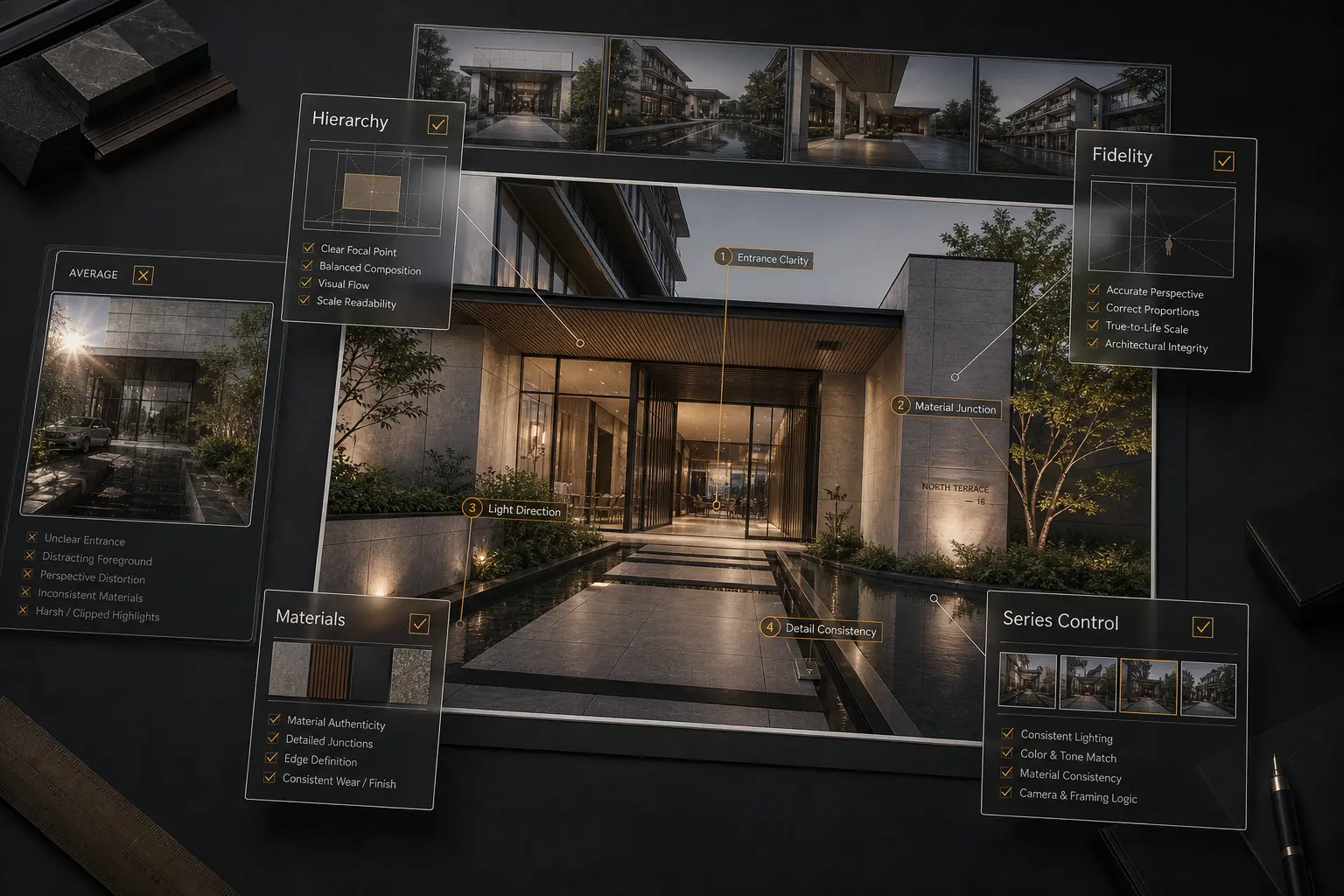
Exceptional images align design intent, composition, architectural accuracy, lighting, materials, context, and presentation. This distinction matters because a polished render can appear convincing at first glance while communicating the building poorly or failing under closer review.
An image may contain detailed textures and dramatic light yet still use a weak camera, obscure the entrance, distort proportions, or contradict other views in the same series. A useful assessment must therefore look beyond surface finish to art direction, technical execution, consistency, revision discipline, and quality control.
Table of Contents
- What High-End Architectural Visualization Actually Means
- Art Direction Creates Visual Hierarchy
- Technical Control Makes the Image Credible
- Consistency Turns a Strong Image Into a Reliable Series
- Quality Control Reveals What Polish Can Hide
- A Framework for Evaluating Archviz Quality
- FAQ
- What to Do Next?
What High-End Architectural Visualization Actually Means
High-end architectural visualization is controlled visual communication. It translates a design into an image that is architecturally faithful, visually deliberate, technically credible, and appropriate for its intended audience. Quality lies in the decisions and in how consistently they support the design.
Photorealism is only one part of credibility. Conversely, an image with restrained realism may communicate massing, spatial sequence, daylight, and material relationships more clearly.
Consider two images of the same lobby. The first uses dramatic light, dense furniture, reflective stone, and intricate textures. It looks polished, but its low camera hides the entrance sequence, reflections confuse material boundaries, and the strongest contrast falls on a decorative object. The second uses a quieter camera and restrained lighting to reveal the arrival route, reception point, ceiling geometry, and connection to the exterior. It is the more resolved piece of architectural communication, even if it appears less theatrical.
A premium result must also survive production. One striking hero image is not equivalent to a controlled deliverable set. Geometry and materials may change, and several cameras may need updating. If quality depends on isolated compositing tricks or undocumented corrections, it can deteriorate quickly. High-end work connects design understanding, art direction, scene construction, rendering, post-production, and revision control into a dependable chain.
Art Direction Creates Visual Hierarchy
Art direction determines what the viewer notices first, what becomes clear after a longer look, and what remains secondary. It begins before final rendering or post-production. Camera position, height, focal length, framing, depth, light, color, scale, and entourage all influence how the architecture is read.
A camera is not merely a recording position. Moving it slightly can reveal an entrance, separate overlapping forms, improve foreground and background relationships, or expose an awkward proportion. Focal length affects perceived depth and spatial compression, while eye level changes the viewer’s relationship to the building. Negative space can give a façade room to read; an overloaded foreground can interrupt the same view.
Visual hierarchy orders attention through contrast, light, color, detail, and composition. The brightest area need not always be the building, but it should not accidentally pull attention from the intended subject. People and objects can clarify scale, occupation, and circulation. They become distractions when their poses, colors, density, or placement compete with the architectural idea.
Lighting should reveal form and material relationships rather than coat the scene in indiscriminate drama. Its direction can describe depth across a façade, separate planes, clarify an interior threshold, or show how daylight enters a room. Mood should follow the communication objective, not function as a preset imposed after the camera and design are established.
Imagine a residential exterior viewed from a low, very wide camera. The building appears imposing, but the perspective stretches its nearest corner, hides the entrance, and reduces the garden to a thin border. A camera closer to natural eye level might reveal the approach, principal volumes, landscape, and illuminated living spaces in one readable composition. Neither position is universally correct. The better choice expresses the intended design idea without unnecessary distortion.
Restraint is often a sign of mature art direction. Dramatic skies, bloom, heavy contrast, saturated planting, and dense props can create immediate impact, but they can also conceal a weak composition. Premium architectural visualization uses such elements selectively, with each serving the image rather than competing for attention.
Technical Control Makes the Image Credible
Technical execution should support the visual direction without becoming the subject of the image. Geometry must be accurate enough for the selected camera and output scale, with correct dimensions, alignments, openings, junctions, and edge conditions. Not every hidden object needs maximum detail, but visible construction relationships must remain believable. An unnaturally sharp slab edge or unresolved window reveal can weaken an otherwise sophisticated frame.
Scene organization also affects image quality. Clear object grouping, dependable material assignments, controlled asset versions, and stable cameras reduce accidental changes. A disordered scene may produce one successful render but become fragile when the design develops or several views need coordinated updates.
Convincing materials depend on behavior, not texture resolution alone. Scale and mapping determine whether stone courses, timber grain, tiles, and fabric read correctly. Roughness and reflectivity govern their response to light, controlled variation prevents repetition, and edge treatment shapes highlights. Material relationships matter: glass, metal, stone, and painted surfaces should not share the same sharpness or reflective character.
Lighting requires similar control. Direction, softness, exposure, color balance, shadow behavior, and the relationship between interior and exterior illumination must agree. A plausible exposure can still bury the primary space in shadow or let a bright window dominate the composition.
Context has its own credibility test. Vegetation, people, furniture, vehicles, weather, and surface imperfections need coherent scale, perspective, sharpness, and illumination. In a close view, out-of-scale stone mapping, mirror-like glazing, razor-sharp edges, and people lit from another direction may each seem minor. Together, they break the visual logic that makes the scene believable.
Rendering and post-production are complementary, not interchangeable. The render should provide dependable geometry, light, reflections, depth, and material response. Post-production can refine tonal hierarchy, atmosphere, integration, and color relationships, but it cannot reliably rescue misunderstood architecture, an unsuitable camera, incoherent lighting, or incorrect geometry. Photorealistic architectural rendering becomes valuable when plausible appearance is joined to architectural and compositional resolution.
Modeling every object at close-up quality wastes effort if the final image never reveals it. Omitting a visible junction that explains how two materials meet is a more consequential shortcut.
Consistency Turns a Strong Image Into a Reliable Series
One exceptional frame can be produced through concentrated effort. Maintaining the same standard across several images and revision rounds is harder. Professional architectural rendering requires dependable geometry, materials, landscape, furniture, lighting logic, and color treatment across the complete deliverable set, not only in the hero image.
Consistency does not mean every image must use the same composition, weather, time of day, or emotional register. A wide exterior, an intimate interior, and a detail view can have different rhythms while describing the same project and design reality. Deliberate variation expands the story; accidental variation creates doubt.
Suppose a three-image apartment series is developed independently. The living-room image receives a warmer timber floor in post-production, the kitchen retains the previous finish, and the bedroom uses an older window-mullion layout. Weather and furniture selections also change without clear intent. Each image may look convincing alone, but side-by-side comparison reveals an unstable project identity.
A shared scene helps, but it is not sufficient. Scene organization, consistent naming, approved assets, camera management, reference images, and documented art direction all reduce drift. Reviews should distinguish changes to the underlying model from view-specific adjustments. A revised façade module, for example, belongs in the shared geometry rather than being painted into one image.
Post-production can create hidden dependencies. If a landscape element, material correction, or façade detail exists only in one composited file, other views may not inherit it. Compositing is not the problem; unclear ownership and propagation are. Production reliability depends on knowing where the authoritative version of each decision lives.
Cross-view review should compare material tone, openings, mullions, furniture, planting, entourage, weather, illumination, and repeated details. This catches contradictions that remain invisible when each frame is assessed alone. Speed matters, but dependable delivery requires preserving design logic as revisions move through the series.
Quality Control Reveals What Polish Can Hide
Quality control should occur throughout production, not only before delivery. Early checks prevent a poor camera or incorrect model from accumulating expensive polish; later checks examine integration, continuity, and presentation. A practical review separates four concerns: architectural correctness, visual coherence, technical integrity, and presentation readiness.
Architectural correctness covers geometry, levels, openings, proportions, material assignments, furniture, landscape, and alignment with current design information. Visible details should agree with the latest references, and framing or atmosphere should not conceal unresolved design areas. Visual plausibility cannot substitute for architectural fidelity.
Visual coherence concerns the image as a directed composition. Check focal emphasis, perspective, scale cues, depth, lighting logic, color relationships, and the role of entourage. View the image at thumbnail size first. If the architecture loses its hierarchy at that scale, additional detail will rarely solve the problem. Then inspect it at full size to assess transitions, edges, materials, and integration.
Technical inspection catches texture repetition, mapping errors, floating objects, intersections, clipping, noise, jagged masks, broken reflections, duplicated assets, inconsistent shadows, and compositing seams. Intentional irregularity is different: variation in stone, weathering, asymmetrical planting, and signs of occupation can improve credibility when they follow the scene’s material and spatial logic.
A dusk exterior may look impressive as a thumbnail because of its luminous interior and deep sky. Closer inspection might reveal inconsistent color temperatures between adjacent rooms, repeated interior layouts, reflections that contradict the surroundings, and poorly masked landscape edges. More contrast will not solve these faults. Each needs correction at the appropriate scene, render, or compositing stage.
Presentation readiness is assessed across the whole series. Compare tonal range, color treatment, weather, design details, and revision status, then confirm that changes have propagated wherever relevant. Archviz quality is not the removal of every irregularity; it is control over errors that weaken communication, credibility, or continuity.
A Framework for Evaluating Archviz Quality
A disciplined evaluation can be organized around five questions:
- Does the image communicate the intended design idea?
- Is the camera purposeful, with a clear visual hierarchy?
- Are geometry, materials, lighting, scale, and context credible?
- Does the image agree with current design information and companion views?
- Can the work withstand revisions and close technical review?
Apply these questions in stages. Begin with first impression: identify where the eye goes and what the image appears to say. Then perform an architectural reading, checking massing, circulation, spatial relationships, proportions, and material intent. Review the visual direction, inspect the image technically at full size, and finish with a series-level comparison.
Weight the criteria according to purpose. A design-development view may prioritize clear spatial information and flexibility under revision. A planning image may need controlled context and unambiguous massing. A competition image may place greater weight on a strong design proposition and atmosphere, while a marketing image may emphasize occupation and emotional clarity. Each purpose changes where effort should be concentrated without removing the need for fidelity.
For a competition image, first state the central proposition in one sentence. If the design is organized around a public route through a building, the camera and light should reveal that route. Atmospheric elements should strengthen depth without obscuring geometry, materials should remain credible, and companion images should reinforce the same proposition from different positions.
High end architectural rendering is the outcome of aligned decisions rather than a visual effect added near completion. The highest standard is not maximum detail everywhere. It is appropriate detail, deliberate emphasis, architectural fidelity, and controlled production wherever a decision affects the final reading.
FAQ
Is photorealism enough for high-end architectural visualization?
No. Photorealism can support credibility, but it does not guarantee clear communication or architectural accuracy. Composition, hierarchy, fidelity, consistency, and purpose remain decisive.
How much detail does an architectural render need?
Detail should match the camera distance, output scale, image purpose, focal priorities, and expected revisions. A close façade view needs resolved junctions and material edges; a distant massing view does not need equally detailed furniture. Useful detail improves the final reading. Unseen complexity adds production and maintenance work without improving the image.
What makes materials look convincing in architectural CGI?
Convincing materials combine correct scale, mapping, roughness, reflectivity, edge behavior, controlled variation, and a coherent response to lighting. Relationships matter as much as individual textures. Stone, glass, metal, timber, and fabric need distinct but compatible behavior within the same scene.
Can AI-generated images meet high-end archviz standards?
AI-assisted imagery can support ideation, atmosphere, and selected production tasks, but visual plausibility does not guarantee architectural correctness. Exact geometry, camera continuity, material intent, repeated details, and consistency across revisions or image sets still require control and review. Its appropriate role depends on how much fidelity and repeatability the output demands.
How should feedback be given on an architectural render?
Separate feedback into design corrections, art-direction decisions, technical defects, and optional refinements. Identify the issue, its priority, the affected views, and the intended outcome. “Reveal the entrance by shifting the camera” is actionable; “make it more premium” is not. Mark cross-view changes clearly so they are not corrected in only one frame.
What to Do Next?
Select one image or a complete series and write its communication objective in one sentence before judging its polish. Review the work first at thumbnail size, then at full size. Compare it with the latest design information and place related views side by side so that visual weaknesses, architectural errors, and cross-view drift are easier to distinguish.
- Check whether the camera and hierarchy express the stated objective.
- Verify geometry, materials, lighting, scale, and context against the design.
- Group findings into architectural, art-direction, technical, and consistency issues.
- Prioritize the few corrections that most improve communication and credibility.