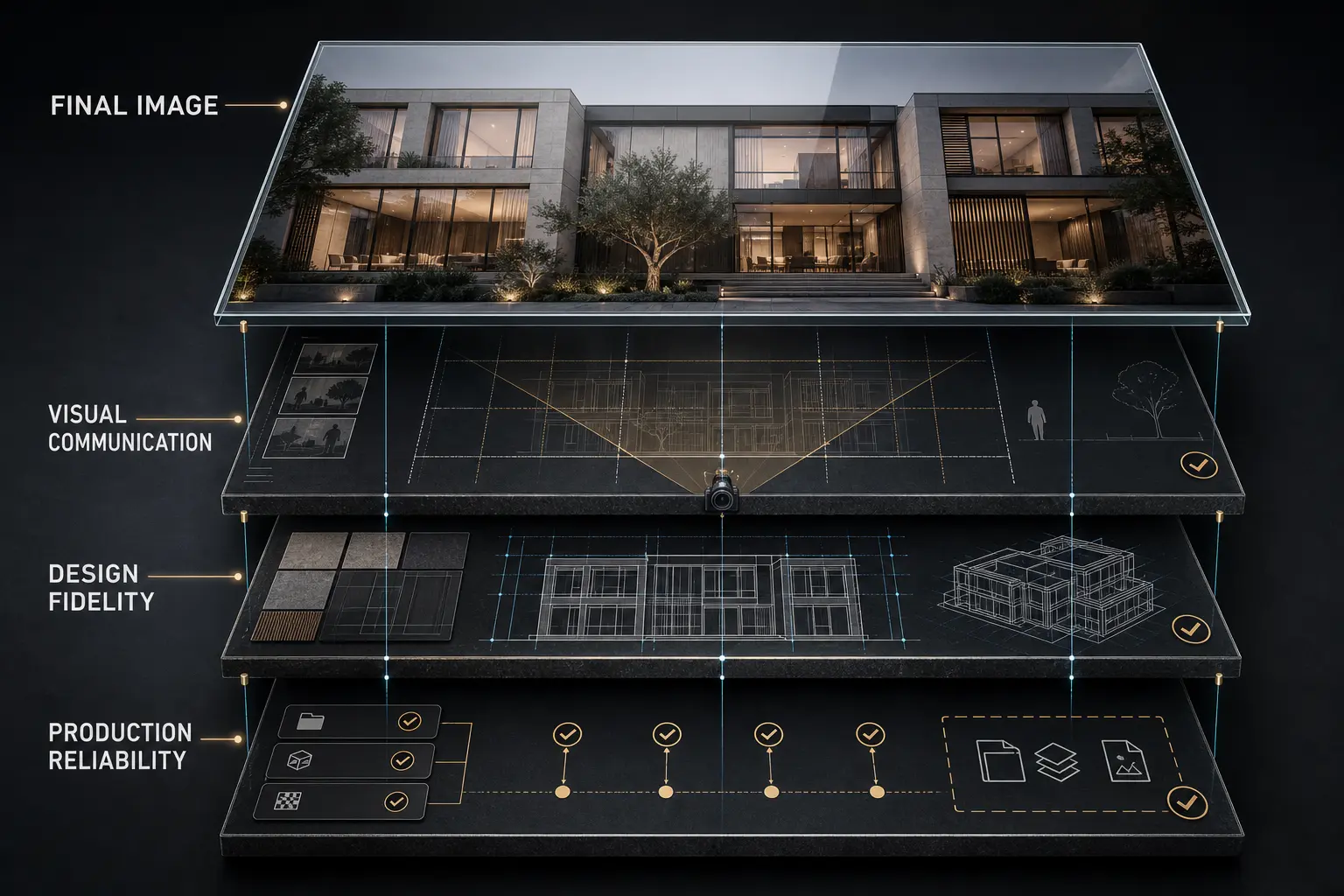
High-end architectural visualization services should deliver more than persuasive imagery. They should preserve design intent, make the architecture legible, support informed review, and produce controlled outputs through a predictable process. A visually impressive render does not prove that geometry, proportions, materials, or spatial relationships are correct. Nor does one successful image demonstrate reliable handling of feedback, design changes, multiple views, and final delivery.
The evaluation therefore extends beyond a finished portfolio. Architects, developers, and design teams need to understand how a specialist interprets source information, develops cameras, handles incomplete decisions, coordinates reviews, and checks the final image set. The most useful framework considers three connected qualities: visual communication, fidelity to the approved design, and production reliability.
Table of Contents
- What Architectural Visualization Services Should Actually Deliver
- Briefing, Design Intent, and Project Scope
- Visual Quality and Architectural Correctness
- Production Workflow, Communication, and Revisions
- Quality Control, Consistency, and Reliability
- How to Evaluate an Architectural Visualization Specialist
- FAQ
- What to Do Next?
What Architectural Visualization Services Should Actually Deliver
Architectural visualization is a communication service supported by image-making. The work includes interpreting the brief, reviewing design information, preparing geometry, organizing the scene, proposing views, developing materials and lighting, coordinating feedback, controlling revisions, and delivering the required files. Labels such as architectural rendering services, 3D visualization services, and architectural CGI services often overlap, so the defined scope matters more than the terminology.
The first measure of quality is visual communication. An image should make the relevant qualities of the project understandable: its massing, spatial sequence, atmosphere, material character, focal hierarchy, or relationship to context. Not every image needs maximal realism. Planning, competition, design-review, and marketing images serve different purposes and may require different levels of detail, atmosphere, restraint, and contextual information.
The second measure is design fidelity. Important geometry, proportions, material intentions, camera relationships, and repeated architectural elements should remain traceable to the supplied design. Interpretation is unavoidable when information is incomplete, but interpretation should not quietly become redesign. Assumptions must remain visible enough to review and revise.
The third measure is production reliability: delivering the agreed scope through clear stages, accountable communication, controlled versions, and appropriate checks. A polished exterior might look convincing while altering the facade rhythm, stretching the building through an aggressive lens, and depicting stone as a glossy surface. Another image can be equally intentional while preserving the approved facade, using a defensible camera, and remaining straightforward to revise. Only the second combines visual success with architectural and operational control.
Output types also affect production. Still images, animation, panoramic material, and real-time outputs are not interchangeable files generated through an identical process. Animation increases demands on continuity and scene completeness; real-time presentation introduces performance and interaction constraints. The intended use and output should be defined before production assumptions are made.
Briefing, Design Intent, and Project Scope
A useful brief begins with the communication objective, not a style reference. What must the image explain, persuade, test, or emphasize? A view showing a development’s relationship to its surroundings requires different camera and context decisions from an image communicating the atmosphere of a residential interior. Style follows purpose.
Source information may include drawings, models, schedules, material references, landscape information, surrounding context, presentation requirements, and known design uncertainties. Model availability does not mean the geometry is ready for visualization. Files may contain outdated options, duplicated objects, missing facade details, placeholder materials, or organization that makes revisions risky. Responsibility for cleanup and additional modeling should be explicit.
A high-end architectural visualization service should distinguish supplied facts from production assumptions. Consider a residential development with a base model, three requested exterior views, an incomplete landscape scheme, and several undecided facade finishes. Production can begin, but temporary landscape and material choices should be recorded as assumptions. Otherwise, polished previews can make provisional decisions appear approved.
Scope should define the number and type of views, dimensions, aspect ratios, context, output formats, model development, review stages, and delivery constraints. It should also assign responsibility for entourage, surrounding buildings, missing geometry, material interpretation, and later design changes. References can communicate mood, composition, season, or finish, but they cannot replace project-specific direction.
Approval responsibilities matter as well. If several stakeholders submit separate comments without an agreed route for consolidation, the visualization team may receive conflicting instructions about cameras, landscaping, materials, and design details. A named decision-maker or review group creates one accountable version of the feedback.
Visual Quality and Architectural Correctness
Visual plausibility and architectural correctness are different qualities. A plausible image has enough coherent light, material behavior, scale cues, and detail to feel believable. An architecturally correct image also represents the relevant design information faithfully. Realistic furniture, atmospheric sunlight, and refined post-production can make an image persuasive while concealing inaccurate dimensions or unresolved geometry.
Camera selection is often the first serious test. Camera height, lens choice, orientation, and framing affect both emotional tone and apparent proportion. A wide lens can reveal more of an interior, but it can also exaggerate foreground furniture, stretch walls, and make a modest room appear substantially larger. A longer lens may produce calmer geometry but compress depth. The right decision depends on what the view must communicate, not which lens creates the most dramatic frame.
Composition should establish hierarchy. Primary architectural ideas need enough emphasis to survive the addition of people, planting, furniture, vehicles, and background activity. These elements provide scale, suggest occupation, and direct attention; they are not merely decoration. Poorly placed entourage can block circulation, disguise facade features, or compete with the architecture.
Lighting should reveal form, depth, circulation, and material character. Dramatic contrast is useful only when it supports the intended reading. If key entrances disappear into shadow or reflective facades lose their articulation, the lighting may be attractive but communicatively weak. High-end architectural visualization treats light as part of architectural explanation rather than a finishing effect.
Materials require more than suitable texture images. Scale, mapping direction, reflectance, roughness, variation, edge behavior, and consistency across repeated surfaces all affect credibility. Oversized timber grain or excessively sharp stone joints can distort perceived scale. Material behavior should also remain coherent between views and under different lighting conditions.
Post-production should strengthen an already resolved image, not conceal broken geometry, poor mapping, or weak lighting. An interior may initially appear convincing because of attractive sunlight and detailed furniture. A disciplined review may still reveal an overly wide camera, incorrect floorboard scale, an obscured circulation route, and composited figures that disrupt spatial clarity. Those issues matter before minor polish.
Production Workflow, Communication, and Revisions
A controlled workflow usually progresses from information review and scene preparation to camera development, draft imagery, material and lighting refinement, formal reviews, final quality control, and delivery. The stages can overlap, but their dependencies remain important. Developing every material before agreeing on cameras spends effort on geometry and surfaces that may not appear in the selected views.
Early camera approval is especially valuable because the camera determines what must be modeled, what context is visible, where detail matters, and how the design will be interpreted. Camera previews do not need final lighting or materials. They need enough information for reviewers to assess position, lens, framing, visible architecture, and communication purpose.
Revisions become clearer when divided into three categories:
- Corrections address work that does not match supplied or approved information.
- Image refinements adjust composition, atmosphere, lighting, entourage, or other aspects of visual development.
- Design or scope changes alter the architecture, project inputs, requested views, or agreed deliverables.
These categories have different consequences. If an approved exterior camera remains valid but the facade changes after material refinement, the work is not simply another visual adjustment. The team must identify affected views, modify geometry, review dependent materials, check shadows and reflections, and confirm any effect on scope or schedule. Treating every request as a generic revision hides those dependencies.
Scheduled reviews are generally more useful than fragmented, continuous comments. Each preview should be developed enough to support the requested decision. Camera reviews should focus on cameras; material reviews should be sufficiently lit to judge material behavior. Feedback should be consolidated, prioritized, and visually referenced where possible. “Make it warmer” is ambiguous; identifying which surfaces, light sources, or color relationships feel too cool provides a testable direction.
Version control protects approved decisions. Files, previews, comments, and design inputs need identifiable status so an outdated balcony option or superseded landscape plan does not return unnoticed. Good communication is not measured only by reply speed. It includes identifying ambiguity, explaining consequences, confirming decisions, and raising dependencies before they become late surprises.
Quality Control, Consistency, and Reliability
Quality control operates at two levels. Image-level review checks whether each frame works on its own. Set-level review checks whether all frames describe the same project. Four exterior images can each look polished while showing different facade materials, moving landscape elements, inconsistent glazing, or an outdated balcony design. A coherent set requires comparison across views, not isolated approval.
Architectural checks should compare imagery with the current source information. Common issues include missing geometry, misaligned repeated elements, incorrect material assignments, visibility errors, superseded design options, and inconsistencies between drawings and models. Where source information conflicts, the discrepancy should be raised rather than resolved invisibly through guesswork.
Visual checks include focal hierarchy, unwanted tangencies, repeated textures, incorrect material scale, abrupt post-production edges, implausible reflections, artificial population patterns, and distracting context. Small details matter when they interrupt the reading of the design, but detail should not replace checking the main architectural idea.
Technical delivery adds another layer of control: resolution, aspect ratio, file format, color handling, naming, version status, and completeness. These checks can appear administrative until an approved composition is cropped to the wrong ratio or a superseded preview enters a presentation package. Delivery quality is part of image quality because the image must function in its intended destination.
Scene organization also affects reliability. Controlled geometry, materials, cameras, assets, and project versions make late changes safer. If one facade material appears across several views, a managed material assignment reduces the chance that only some images receive the update. Organized scenes do not eliminate errors, but they make them easier to detect, trace, and correct.
For multi-image 3D visualization services, reliability means preserving decisions across the set, identifying risk early, and recovering from production problems without losing control of approved work. Speed remains valuable under compressed deadlines, but only when review and validation remain intact.
How to Evaluate an Architectural Visualization Specialist
Start with fit for purpose. A portfolio does not need to contain an identical building type to demonstrate relevant judgment. Look for controlled composition, legible architecture, credible material behavior, appropriate atmosphere, and restraint. Review image sets as well as hero images; consistency across several views reveals capabilities that a single dramatic frame cannot.
Then examine the proposed process. Ask how source files are reviewed, how incomplete or conflicting inputs are handled, and which assumptions will be recorded. Clarify when cameras, materials, lighting direction, and final details are reviewed. The answers should reveal decision points and dependencies, not merely promise regular updates.
The written scope should identify:
- The number and type of views, including required dimensions and formats.
- Responsibility for modeling, cleanup, context, materials, and entourage.
- The review stages and route for consolidated feedback.
- How corrections, image refinements, and design changes are treated.
- How consistency and final output checks will be completed.
Compare two hypothetical proposals. One specifies image count, resolution, and delivery date but says little about source review, camera approval, or design changes. The other defines inputs, identifies a camera stage, describes development reviews, assigns feedback responsibility, and explains final checks. The second does not guarantee stronger creative work, but it provides a clearer basis for evaluating delivery risk.
Provider labels do not settle the question. An architectural rendering studio, an independent specialist, and a team offering architectural CGI services may each be suitable. Studio size is not an automatic proxy for reliability, just as price is not a complete proxy for visual judgment. The production approach must fit the project’s design maturity, stakeholders, deadline, output requirements, and communication purpose.
The strongest evaluation combines three tests. Does the work show visual judgment appropriate to the project? Does the process preserve and clarify design intent? Is delivery supported by credible review, change control, consistency, and quality assurance? Architectural visualization services should be convincing across all three because weakness in any one can compromise the result.
FAQ
What is usually included in architectural visualization services?
Inclusions vary and should be confirmed in the written scope. A service may cover source-file review, model cleanup or additional modeling, scene development, cameras, materials, lighting, context, draft reviews, agreed revisions, post-production, final outputs, and handover requirements. The label alone does not establish which tasks are included.
What information is needed before visualization production starts?
Useful inputs include the communication objective, current drawings or models, material direction, landscape and context information, requested views, references, output requirements, design status, deadlines, stakeholders, and known uncertainties. Missing information does not necessarily prevent production if assumptions are documented and assigned for approval.
What affects the cost of architectural rendering services?
Cost is influenced by project complexity, number and type of views, model readiness, context requirements, design maturity, material development, output format, schedule, approval structure, and revision scope. Unresolved geometry and extensive surroundings require a different production commitment from coordinated source files and a limited view set.
How should revisions be defined in an architectural visualization project?
Revisions should distinguish corrections, image refinements, and changes to the underlying design or scope. An effective agreement identifies review stages, feedback responsibilities, included revision boundaries, and the process used when approved inputs change. This makes production consequences visible without treating legitimate design development as a communication failure.
Can a portfolio prove that a visualization specialist is reliable?
A portfolio can demonstrate visual judgment, technical finish, range, and consistency, but it cannot prove how feedback, versions, deadlines, ambiguity, or quality assurance are handled. Reliability should be evaluated through both finished work and the proposed briefing, review, change-control, and validation process.
What to Do Next?
Prepare a one-page project brief before evaluating proposals. Define the communication purpose, design status, available source material, unresolved decisions, required views, output formats, contextual needs, stakeholders, review stages, and delivery constraints. Separate must-have views from optional ones, and assign one route for consolidated feedback.
Review each proposed service against the three-part framework: visual communication, architectural fidelity, and production reliability. Confirm how cameras will be approved, assumptions recorded, feedback classified, design changes handled, consistency checked, and final files validated. The appropriate workflow will vary, but these decisions should be explicit before detailed production begins.