API workflow automation is the coordinated movement of data and actions across systems through APIs, triggers, transformation rules, and control logic. Connecting two endpoints is only the first step. A dependable workflow must also handle invalid data, duplicate events, delayed responses, partial failures, authentication changes, and systems that temporarily become unavailable.
A single business process may cross several applications, databases, approval points, and external services, each with its own data model and failure behavior. Designing that process requires clear boundaries, ownership, mappings, completion conditions, and recovery paths. The goal is not merely to make systems communicate, but to produce the intended business outcome repeatedly and recover when execution leaves the happy path.
Table of Contents
- API Workflow Automation Explained
- Map the Process Before Connecting the APIs
- How API Workflow Integrations Move Data
- Design for Validation, Retries, and Failure
- Choose an API Orchestration Pattern
- Build, Test, and Maintain the Workflow
- FAQ
- What to Do Next?
API Workflow Automation Explained
API workflow automation coordinates triggers, requests, transformations, decisions, updates, and failure handling across multiple systems. An API exposes operations such as retrieving a record, creating an account, or changing a status. The workflow determines when those operations run, which data they receive, how their results affect subsequent steps, and what happens when an operation does not produce the expected result.
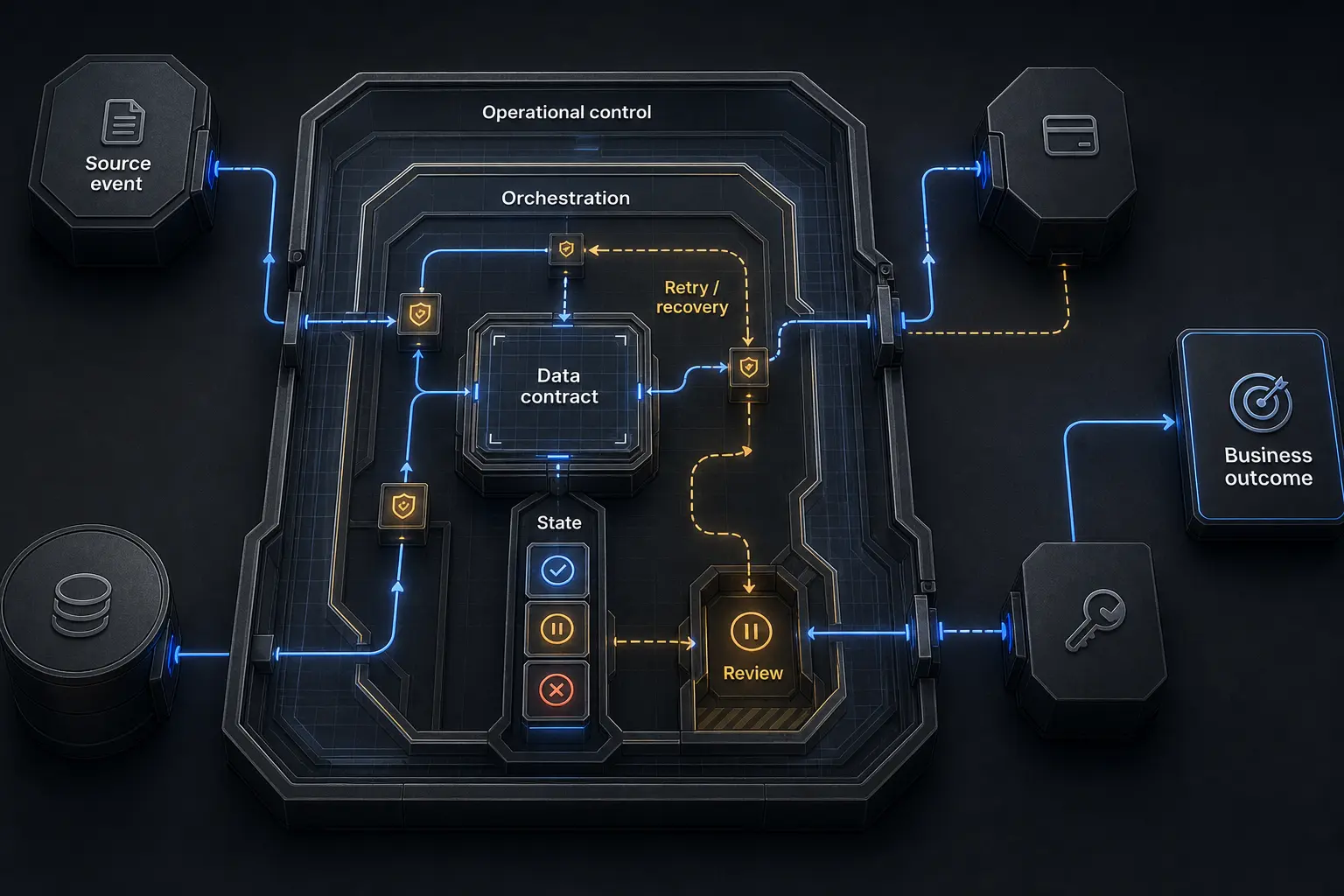
Several responsibilities sit behind even a modest API automation. A source system produces an event or supplies data. A destination system accepts an operation. An orchestrator sequences the work and applies business logic. Credentials authorize access, while a data contract defines the expected payload, field types, required values, and identifiers. Workflow state records what has happened so execution can continue, pause, or recover without guessing.
A useful mental model separates the system into four layers:
- Event transport determines how work starts, such as a webhook, schedule, queue message, or manual approval.
- The data contract defines the meaning and structure of information exchanged between systems.
- Orchestration logic controls sequencing, branching, transformation, and decisions.
- Operational control covers validation, state, retries, observability, recovery, and human intervention.
Consider a hypothetical customer-onboarding process. A signed agreement triggers retrieval of the customer record. Required fields are validated, a billing account is created, application access is provisioned, an internal database record is inserted, and the responsible team is notified. These actions form one business system integration even though they cross several APIs. A successful billing request does not prove that onboarding finished.
Most predictable workflows should remain deterministic. Explicit rules are easier to test for field validation, status checks, permissions, and transactional updates. An LLM may be useful for a bounded task involving unstructured text, while an agent implies greater delegated decision-making, such as choosing among available tools. Neither is required simply because APIs are involved.
Map the Process Before Connecting the APIs
Begin with the operational process, not a list of available endpoints. Define the initiating event, required inputs, expected outputs, participating systems, decisions, side effects, completion condition, and exception paths. This turns a vague request to “connect the platforms” into a specification that can be implemented and tested.
Data ownership is one of the first decisions. Each important type of information should have an identified system of record. In the onboarding example, an internal customer database might own the canonical customer identifier, while the billing platform owns payment status. The agreement platform can report that a document was signed without becoming the authoritative source for every customer field.
Stable identifiers matter because names and email addresses are usually poor permanent join keys. The workflow needs to know how a source customer ID maps to an internal ID and to records created in downstream systems. That mapping may need to be persisted, especially if later callbacks contain only the downstream provider’s identifier.
For each important operation, document its preconditions and postconditions. Creating a billing account might require a valid legal name, billing address, currency, and internal customer ID. Its postcondition is not merely a successful HTTP response; it is a valid billing record whose identifier has been stored against the correct customer. This distinction prevents transport success from being mistaken for process completion.
The process map should also identify timing. Some API calls finish synchronously and return a usable result immediately. Others start asynchronous work and later send a callback or require a status check. Access provisioning, for example, might be accepted now but completed several minutes later. The onboarding state should therefore remain “provisioning pending,” not “complete.”
Human approval belongs in the map as an explicit state and decision boundary. If unusual account terms require review, the workflow should pause, preserve its context, and resume from the approved point. A workflow API integration becomes easier to reason about when handoffs, ownership, and completion criteria are settled before endpoint configuration begins.
How API Workflow Integrations Move Data
Events can enter a workflow through a webhook, scheduled poll, queue, or direct request. Webhooks support event-driven processing because a source system pushes a notification when something changes. Polling is necessary when a system cannot emit suitable events, and it can also provide reconciliation for events that were delayed or missed. Neither mechanism guarantees that an event will arrive exactly once.
In the onboarding scenario, a signed-agreement webhook should be verified and acknowledged according to the source system’s requirements. If downstream processing will take time, receipt and processing should be separated. The webhook handler can record or queue the event promptly, while another execution performs customer retrieval, billing, and provisioning. This reduces the risk that a slow downstream service causes the source to treat delivery as failed.
Authentication controls what the workflow may do. Systems may use API keys, access tokens, or delegated authorization, but the durable design principles remain consistent: store secrets in an appropriate managed credential mechanism, grant only the required scope, separate environments, and plan for expiration or rotation. Credentials should not be embedded in transformation logic, copied into payloads, or written into execution logs.
Requests and responses carry structured payloads between endpoints. The orchestrator must interpret status codes, follow pagination where a complete collection is required, and validate the response body rather than assuming that every syntactically successful response contains usable data. It also needs explicit timeout behavior for services that accept a connection but do not respond promptly.
Data rarely moves unchanged. API integration automation commonly requires field renaming, type conversion, normalization, and identifier mapping. A source may store an address as one string while the billing API expects separate street, city, region, and postal fields. Dates, currency values, booleans, and empty values can also have incompatible representations. Transformation logic should produce a defined internal shape before generating destination-specific payloads.
The orchestrator holds the flow together. It sequences calls, branches on conditions, passes outputs between steps, and persists context when execution cannot finish in one run. To automate APIs reliably, send each destination only the fields it needs and retain the identifiers required for later tracing. This limits unnecessary data exposure while preserving enough context to understand each side effect.
Design for Validation, Retries, and Failure
Reliable API workflow automation validates at several boundaries. Input validation checks structure, types, and required fields. Business-rule validation checks whether the action is allowed, such as whether an agreement is signed or an account is eligible for provisioning. Response validation confirms that a downstream result contains the expected identifier, status, and meaning. A successful request with an incomplete or contradictory response is still an exception.
Idempotency protects side effects from repeated execution. Webhooks can be delivered more than once, workers can restart, and requests can time out after a destination has already completed the operation. The workflow should use source-event identifiers, idempotency keys where supported, uniqueness constraints, or stored deduplication records. Before creating a billing account, it may also check whether the onboarding state already contains one.
Failures should be classified rather than sent through one generic retry loop:
- Transient failures include timeouts, temporary unavailability, and some rate-limit responses. These can often be retried with limits and backoff.
- Permanent failures include malformed data, insufficient permissions, or a rejected business rule. Repeating the same request unchanged will not help.
- Ambiguous failures occur when the workflow cannot tell whether a side effect completed. These require a status lookup, reconciliation, or human review before another create operation is attempted.
Partial failure is the defining challenge in multi-system workflows. Suppose the billing account is created, but access provisioning times out. The workflow should retain the billing identifier, mark onboarding as incomplete, and retry only the provisioning operation. If the retry policy is exhausted, it should place the item in an exception queue or review state. Blindly restarting the full process could create another billing account.
Not every completed action can be rolled back. Where a compensating operation exists, such as deactivating an incorrectly provisioned account, its business consequences still need consideration. Where compensation is unsafe or unavailable, reconciliation is more appropriate: record the discrepancy, preserve the relevant evidence, and route it to a defined owner.
Correlation IDs, execution logs, and persistent status records make recovery possible. A correlation identifier should connect the source event, internal workflow instance, and downstream records. Useful logs identify the failed step, error category, retry count, and relevant record IDs without indiscriminately recording sensitive payloads. Reliability comes from controlled recovery, not retries alone.
Choose an API Orchestration Pattern
API orchestration should be proportional to timing, complexity, volume, and business risk. A short, stable workflow with three synchronous calls may work as a direct chain. It is understandable, quick to build, and may not need a separate state store if every step completes immediately and repeated execution has no dangerous side effects.
A centralized workflow orchestrator becomes useful when the process includes several branches, transformations, reusable operations, or exception paths. Shared components can standardize authentication, normalization, logging, and error classification. Abstraction should remain purposeful, however. Splitting every minor mapping into a separate subworkflow can make execution harder to trace rather than easier to maintain.
Persisted asynchronous processing is safer when operations are delayed, externally rate-limited, or prone to partial failure. Queues separate event intake from execution and allow work to wait without holding an open request. A state store records which steps have finished, their identifiers, approval status, retry history, and the next permitted action.
Compare two onboarding versions. A low-volume process might retrieve one customer record, create one account, and send one notification synchronously. A higher-risk version might require approval, billing creation, delayed provisioning, callbacks from several services, and later reconciliation. Extending the first design into one long point-to-point chain would make retries and recovery increasingly dangerous. The second needs persisted state and resumable execution.
Architecture also affects long-term business system integration. Point-to-point connections are initially simple but can duplicate mappings and error behavior as the number of systems grows. Central orchestration improves consistency but introduces a component that requires ownership and monitoring. Event-driven designs reduce tight timing dependencies, yet require stronger handling of ordering, duplication, and eventual consistency.
AI is optional. An LLM could extract structured onboarding fields from an unstructured document, provided its output conforms to a schema and is validated before use. Deterministic logic should still control identifiers, authentication, permissions, payment status, and account creation. Agentic behavior is justified only when bounded tool selection or adaptive decisions are genuinely part of the problem, with guardrails and approval for consequential actions.
Build, Test, and Maintain the Workflow
Build a narrow end-to-end path before implementing every branch. Use representative test records, controlled credentials, and a non-production environment where possible. Confirm that the trigger reaches the orchestrator, transformations produce the expected contract, destination records are created correctly, identifiers are stored, and the workflow reaches a valid completion state.
Then test failure behavior deliberately. For the onboarding workflow, send the same event twice, remove a required billing field, use an expired credential, delay the provisioning response, return a malformed payload, and make a downstream service unavailable. Verify whether each condition should be rejected, retried, reconciled, or sent for review. Test the resulting side effects, not only the response displayed by the automation tool.
Mappings and workflow logic should be versioned so schema changes can be introduced deliberately. Deployment checks should confirm credentials, endpoint environments, required fields, callback configuration, and state-store access. A rollback plan must account for external side effects: restoring an earlier workflow version does not remove accounts or transactions already created elsewhere.
Observability should answer operational questions quickly. Useful records include execution status, correlation ID, failed step, error category, retry count, duration, and unresolved exception state. Payload logging should be selective because customer, financial, or regulated information may require redaction and controlled retention.
Maintenance needs named responsibilities. Someone must own alerts, failed-item review, credential renewal, API schema changes, and periodic reconciliation between systems. Alerting only on total workflow failure is often insufficient; an item can remain pending indefinitely without producing a crash. Monitoring should therefore include stalled states and unresolved exceptions as well as explicit errors.
Production API automation is an operated system, not a configuration completed after its first successful run. APIs change, tokens expire, data quality drifts, and business rules evolve. Without maintenance ownership and recovery procedures, API integration automation becomes hidden operational risk precisely because routine executions remain out of sight.
FAQ
How is API workflow automation different from API integration?
API integration establishes communication and data exchange between systems. API workflow automation coordinates one or more integrations around triggers, sequencing, business rules, transformations, state, validation, exceptions, and completion conditions. An integration can exchange data successfully while the wider workflow remains incomplete.
When should a workflow use webhooks instead of polling?
Use webhooks when a source can push timely events and the workflow benefits from event-driven execution. Polling is appropriate when push events are unavailable or periodic reconciliation is required. Webhook designs must still handle duplicates and missed deliveries, while polling must account for latency, request volume, pagination, and reliable checkpointing.
How can duplicate API actions be prevented?
Use idempotency keys where supported, preserve source-event identifiers, store deduplication records, enforce uniqueness constraints, and check existing workflow state before creating a side effect. Duplication protection and retry behavior must be designed together because retries often occur when the result of the first request is uncertain.
Where should API credentials be stored in an automated workflow?
Store credentials in a managed secret or credential mechanism rather than hardcoding them in workflow logic, payloads, or logs. Apply least-privilege scopes, separate credentials by environment, control who can access them, and monitor expiration and rotation requirements.
Does API orchestration need AI or agents?
No. Most predictable integrations are safer and easier to test with deterministic workflow logic. LLMs can help with bounded unstructured-data tasks if they return structured, validated outputs. Agentic behavior is appropriate only where controlled tool selection or adaptive decisions are genuinely needed, with clear guardrails and human approval for consequential actions.
What to Do Next?
Select one bounded business process rather than starting with a broad goal to connect every system. Write down its initiating event, required inputs, participating systems, system of record for each important data type, expected output, and precise completion condition. Include approval points and failure paths before choosing an orchestration tool.
- Map the required API operations, identifiers, field transformations, and external side effects.
- Identify actions that must not be duplicated and decide where workflow state will be stored.
- Classify likely failures as retryable, non-retryable, ambiguous, or reviewable.
- Build one narrow end-to-end path and test duplicate events, invalid data, timeouts, and unavailable services.
- Verify recovery and reconciliation behavior before expanding the workflow.