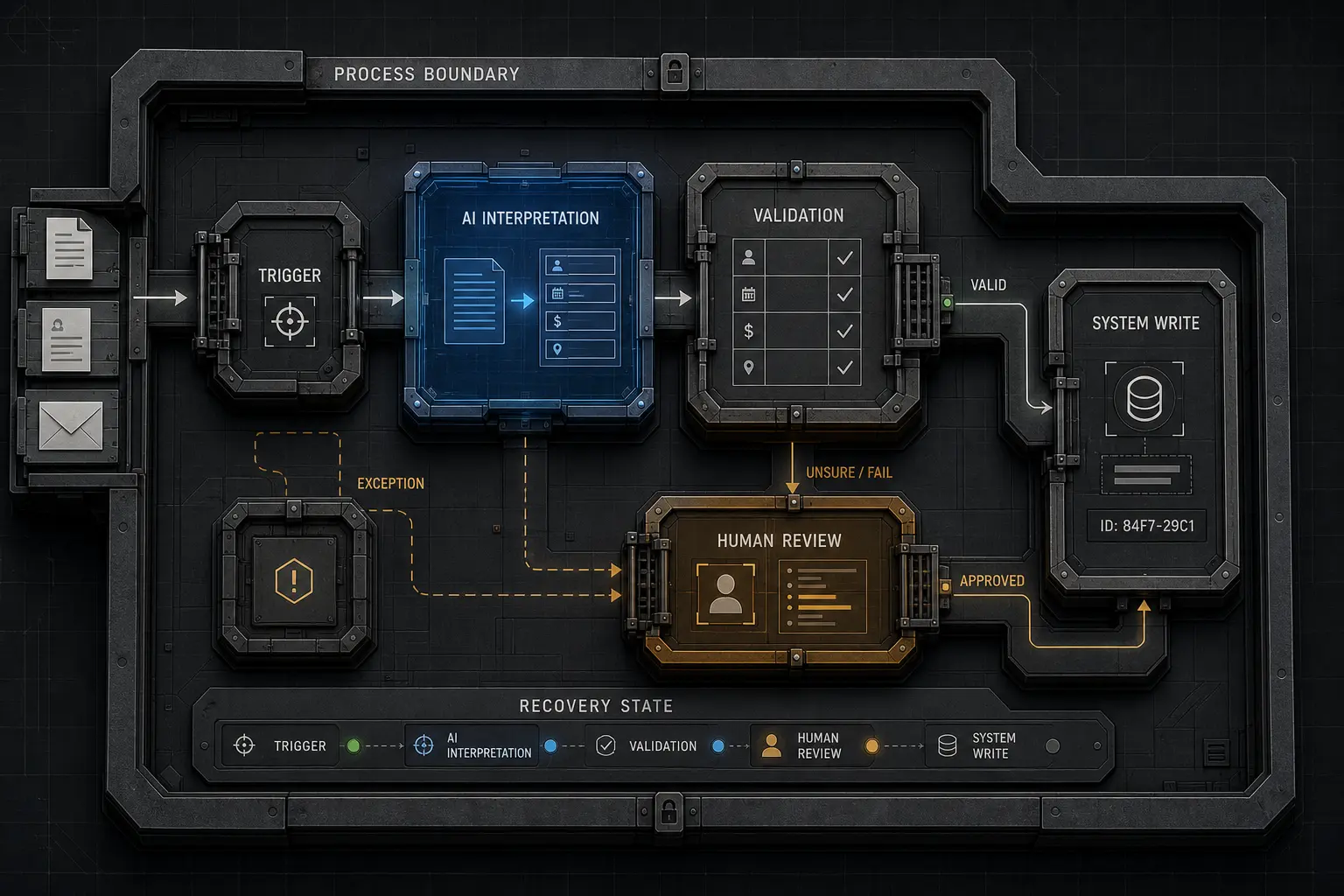
AI workflow automation coordinates AI capabilities with deterministic automation, software integrations, business rules, and human review. An isolated model response is not a reliable workflow. A production system must also control how information enters, what validates it, which actions follow, and how uncertain or failed cases are handled.
The practical design problem is deciding which steps require interpretation, which should remain rule-based, how data moves between systems, and what happens when confidence is low or a dependency fails. A process-first method makes those boundaries visible before probabilistic output is allowed to influence decisions that require exactness, accountability, or recovery.
Table of Contents
- What AI Workflow Automation Actually Means
- Map the Business Process Before Adding AI
- The Architecture of a Reliable AI Workflow
- Assign AI, Rules, and Human Review to the Right Decisions
- Design for Failures, Exceptions, and Observability
- Implement and Improve the Workflow in Controlled Stages
- FAQ
- What to Do Next?
What AI Workflow Automation Actually Means
AI workflow automation is the orchestration of triggers, data movement, deterministic logic, AI processing, validation, system integrations, and human intervention around a defined business outcome. The model is usually one component inside that system. It might interpret a document or classify a message, but the surrounding workflow turns that interpretation into a controlled operational result.
Consider a recurring supplier-invoice process. An email arrives with a PDF attachment. AI extracts the supplier name, invoice number, dates, line items, and totals from a variable layout. Rules check required fields, verify the arithmetic, search for duplicates, and compare the supplier with an approved record. A person reviews unresolved exceptions before approved data is written to an accounting system.
This example contains two kinds of computation. Deterministic automation handles actions that should produce the same result from the same input: calculations, required-field checks, approval thresholds, and routing. AI handles probabilistic tasks in which language, layout, or meaning must be interpreted. Its output can be useful without being guaranteed correct.
An AI-assisted workflow gives a person model-generated information or recommendations. A fully automated path completes a bounded process without routine intervention but still relies on predefined controls. An agentic workflow delegates some dynamic planning or tool selection to a model. Most AI automated workflows do not need agentic behavior; fixed orchestration is often easier to test, explain, and recover.
Intelligent workflow automation should therefore describe a designed process with controlled AI capabilities, not merely an AI-branded interface. Reliability belongs to the complete workflow. A polished response has little operational value if it references the wrong record, bypasses policy, creates a duplicate transaction, or fails when the next system is unavailable.
Map the Business Process Before Adding AI
Begin with the process boundary rather than a model or automation platform. Define the event that starts the process and the outcome that ends it. For invoice processing, the trigger might be receipt in a designated mailbox, while completion means an approved, uniquely identified record has been accepted by the accounting system. Extracting information from a PDF is only one task inside that boundary.
Map the inputs, outputs, participants, systems, stored records, handoffs, and decisions between those points. Identify who owns the process and who is responsible when it cannot complete normally. In AI business workflows, the most visible manual task is not always the main source of delay or risk. The constraint might instead be a missing purchase-order reference, inconsistent supplier data, or an unclear approval policy.
Exceptions often determine whether the design survives production. An invoice might use an unfamiliar layout, omit an identifier, duplicate an earlier submission, conflict with purchase-order data, or exceed an approval threshold. Each case needs an explicit destination: automated rejection, a request for information, a review queue, or escalation to a defined role.
For every important field or decision, identify the source of truth. The supplier name on a document may be extracted correctly but fail to match the legal supplier record. The invoice total may appear in the PDF, while the accounting system remains authoritative about whether the invoice already exists. Model output is evidence to evaluate, not verified system state.
Remove avoidable ambiguity before adding AI. A structured form, required reference field, document template, or direct integration may solve part of the problem more reliably than interpretation. Automation does not repair unclear ownership, inconsistent policies, or uncontrolled inputs. It reproduces those weaknesses faster.
The Architecture of a Reliable AI Workflow
A reliable architecture begins with a trigger: an inbox event, webhook, form submission, schedule, or database change. The workflow assigns a stable identifier and verifies that the input is usable before invoking probabilistic processing. For an invoice, this can include checking attachment presence, file type, size constraints, and whether the message has already been processed.
Incoming data is then normalized and classified. Attachments may need to be separated from email signatures, converted into an accepted representation, and associated with metadata such as sender, receipt time, and message identifier. Classification can route invoices, credit notes, statements, and irrelevant attachments into different paths.
In LLM workflow automation, the model-processing layer belongs only where interpretation is necessary. A model might extract an invoice number, supplier name, currency, dates, totals, and purchase-order reference into a defined schema, using explicit null values for missing information. Restricted categories and required fields make the response usable by software. Free-form prose should not control downstream transactions.
Structured output is not necessarily correct output. A response can satisfy a schema while containing the wrong invoice number or confusing tax with the total. Schema validation checks field types and acceptable values. Business validation checks arithmetic, supplier identity, duplicate status, required references, policy thresholds, and relationships between fields.
Deterministic branching decides what happens next. Valid records can proceed to approval routing; missing or conflicting data goes to review. Permissions and approval rules should remain explicit rather than being inferred by a model. Once approved, the workflow sends the data through a controlled integration and records the returned system identifier.
State makes this sequence recoverable. The workflow should know whether extraction completed, validation passed, approval is pending, or the final write failed. Stable identifiers and idempotent operations prevent retries from creating duplicates. Statuses, timestamps, validation results, errors, and review decisions provide an operational record. Orchestration coordinates these components; it is not the intelligence itself.
Assign AI, Rules, and Human Review to the Right Decisions
A practical AI process automation design assigns each step to AI, deterministic rules, or people. The choice should reflect the decision, not a goal of maximizing automation. Evaluate ambiguity, consequence of error, reversibility, required explanation, and available validation.
Deterministic automation is appropriate for exact transformations, calculations, permissions, known conditions, routing rules, record lookups, and repeatable system actions. If invoices above a defined amount require a particular approval role, that is a business rule. Asking a model to infer the route would make an exact policy unnecessarily probabilistic.
AI is useful when inputs vary and interpretation is required. It can extract fields from inconsistent documents, classify free-text requests, summarize correspondence, or map varied language into constrained categories. Bound its role with an output contract: limited categories, required fields, explicit null states, and documented escalation conditions.
Human review belongs around high-consequence approvals, novel exceptions, conflicting evidence, policy-sensitive decisions, and subjective judgment. In the invoice workflow, AI can extract fields and rules can verify totals, but a person may need to act when the purchase-order reference is absent, the supplier conflicts with the master record, or the amount crosses an approval threshold.
Confidence can help route work, but it is not proof of correctness. Scores are not necessarily calibrated consistently, and a confident answer can still be wrong. A safer design combines confidence with independent checks and consequence. A low-risk classification with strong validation may proceed automatically, while a consequential financial field requires corroboration or review.
Review should target genuine uncertainty rather than every case. If each output requires complete re-entry, little has been automated. A useful review item presents the source evidence, extracted values, failed checks, and specific decision required.
Agentic behavior is justified when a process genuinely requires dynamic tool selection or planning that cannot be represented well as a fixed path. It also introduces wider decision boundaries and more complex recovery. For a stable invoice process, predefined steps and bounded AI calls are usually safer than allowing a model to choose which records to query or actions to execute.
Design for Failures, Exceptions, and Observability
Production workflows need separate handling for business exceptions and technical failures. A missing purchase-order reference is an expected business exception: the systems are working, but the case cannot proceed under normal rules. An unavailable accounting API is a technical failure. Combining both into a generic error state obscures ownership and recovery.
Anticipate malformed files, missing fields, ambiguous extraction, conflicting records, duplicate events, unavailable APIs, expired credentials, rate limits, and partial completion. Each condition needs a defined outcome. Some should stop immediately, some should enter a review queue, and some should retry after a controlled delay.
Retry policy should depend on the error. Retrying a temporary service interruption can be sensible; retrying invalid credentials or a rejected payload only creates noise. Before repeating a downstream action, the workflow must determine whether the previous request completed. Stable external references and idempotent writes help prevent duplicates when a response is lost after the receiving system has accepted the record.
State preservation is critical during partial failures. If extraction and validation succeed but the accounting API fails, the workflow should retain the validated record and identify the failed integration stage. It can resume from that point instead of repeating extraction, producing different output, or recreating an invoice that already exists.
Logging supports observability only when it explains the workflow’s condition. Useful records include the input reference, processing stage, validation result, rule or model outcome, review action, downstream identifier, error category, and final status. Sensitive content should not be retained indiscriminately; access, privacy, retention, and audit requirements must shape what is logged.
Operational monitoring should look beyond whether executions ran. Repeated supplier mismatches, growing review queues, recurring schema failures, or records stuck in an intermediate state can reveal a degrading process even when individual executions report success. Reliable AI automated workflows make these patterns visible and assign responsibility for responding.
Prompts, schemas, validation rules, credentials, and integrations are maintained system components. Changes to a model, policy, source format, or receiving API can alter behavior. Observability identifies symptoms; ownership and controlled maintenance restore reliability.
Implement and Improve the Workflow in Controlled Stages
Choose one bounded process with repeated demand, identifiable inputs, a clear completion state, and exceptions that can be named. Define a successful execution before building. For the invoice example, success is not that the fields look plausible. It is a validated record reaching the correct destination once, with the required approvals and an auditable status.
Build the deterministic path and integrations first where practical. Confirm that triggers, identifiers, record lookups, routing, permissions, and destination writes work with controlled test data. Then add AI to one interpretation-heavy task, such as document extraction, using a defined schema and explicit validation requirements. This contains uncertainty instead of spreading it across the workflow.
Testing should represent the real input range. Include ordinary documents, unfamiliar layouts, missing fields, contradictory totals, duplicate submissions, irrelevant attachments, malformed files, and unavailable dependencies. Test whether invalid answers are contained, exceptions reach the right person, retries are safe, and downstream systems remain consistent.
For consequential processes, begin in observation or recommendation mode. The workflow can extract, classify, and propose routing while people retain the final decision. Comparing system output with reviewed outcomes exposes weak instructions, incomplete schemas, and missing rules without allowing errors to trigger uncontrolled actions.
Autonomy can increase in stages: observation, recommendation, approval-based execution, and bounded automatic action. The invoice workflow might first classify attachments, then extract fields for confirmation, automate deterministic checks, and only later allow validated low-risk records to proceed without manual entry. Escalation and rollback paths should remain available.
AI workflow automation is not complete at launch. Someone must own credentials, prompt and schema versions, policy changes, integration updates, exception queues, and retesting. AI business workflows also need review as the underlying process changes. A prototype demonstrates a possible path; a production workflow defines who maintains it as dependencies and operating conditions move.
FAQ
Does AI workflow automation require an AI agent?
No. Most workflows can use a fixed sequence with deterministic branching, bounded AI calls, validation, and human review. Reserve agentic behavior for cases that genuinely require dynamic planning or tool selection. It also requires tighter limits, state management, observability, and recovery because the execution path is less predictable.
Which business processes are good candidates for AI workflow automation?
Good candidates have repeated demand, recognizable inputs, clear outputs, stable ownership, and exceptions that can be identified and routed. AI is particularly useful when unstructured documents or messages require interpretation. Poorly understood, constantly changing, unbounded, or high-consequence processes are risky starting points.
How should sensitive data be handled in an AI automated workflow?
Minimize the data collected and sent to each component, restrict access, define retention and logging boundaries, protect credentials, and use providers approved for the relevant data. Human access also needs controls. Privacy and compliance requirements depend on the data, jurisdiction, contracts, and tools, so appropriate legal, security, or compliance review may be required.
How do you test LLM workflow automation?
Use representative normal cases, edge cases, missing information, conflicting evidence, malformed inputs, irrelevant or adversarial content, duplicates, and dependency failures. Evaluate schema validity, task correctness, routing, recovery, and downstream effects. A plausible response is insufficient if it causes an incorrect operational action.
How do you maintain AI workflows over time?
Assign ownership for monitoring, credentials, prompts, schemas, validation rules, integrations, and exception queues. Version important changes and retest after updates to models, policies, processes, or connected systems. Recurring exceptions often reveal that the workflow no longer matches its operating environment.
What to Do Next?
Choose one bounded, repeated process and map its trigger, completion state, owner, systems, inputs, outputs, decisions, and common exceptions. Label each step as deterministic, interpretation-based, or approval-dependent. For every important field, identify the source of truth and decide what must validate any AI-generated value.
Define a structured output contract, escalation path, recovery behavior, logging boundary, and maintenance owner before automating consequential actions. Assemble normal and failure test cases, then run the first version in observation or review-first mode. Keep the scope narrow enough that incorrect behavior remains visible, explainable, and reversible before increasing autonomy.