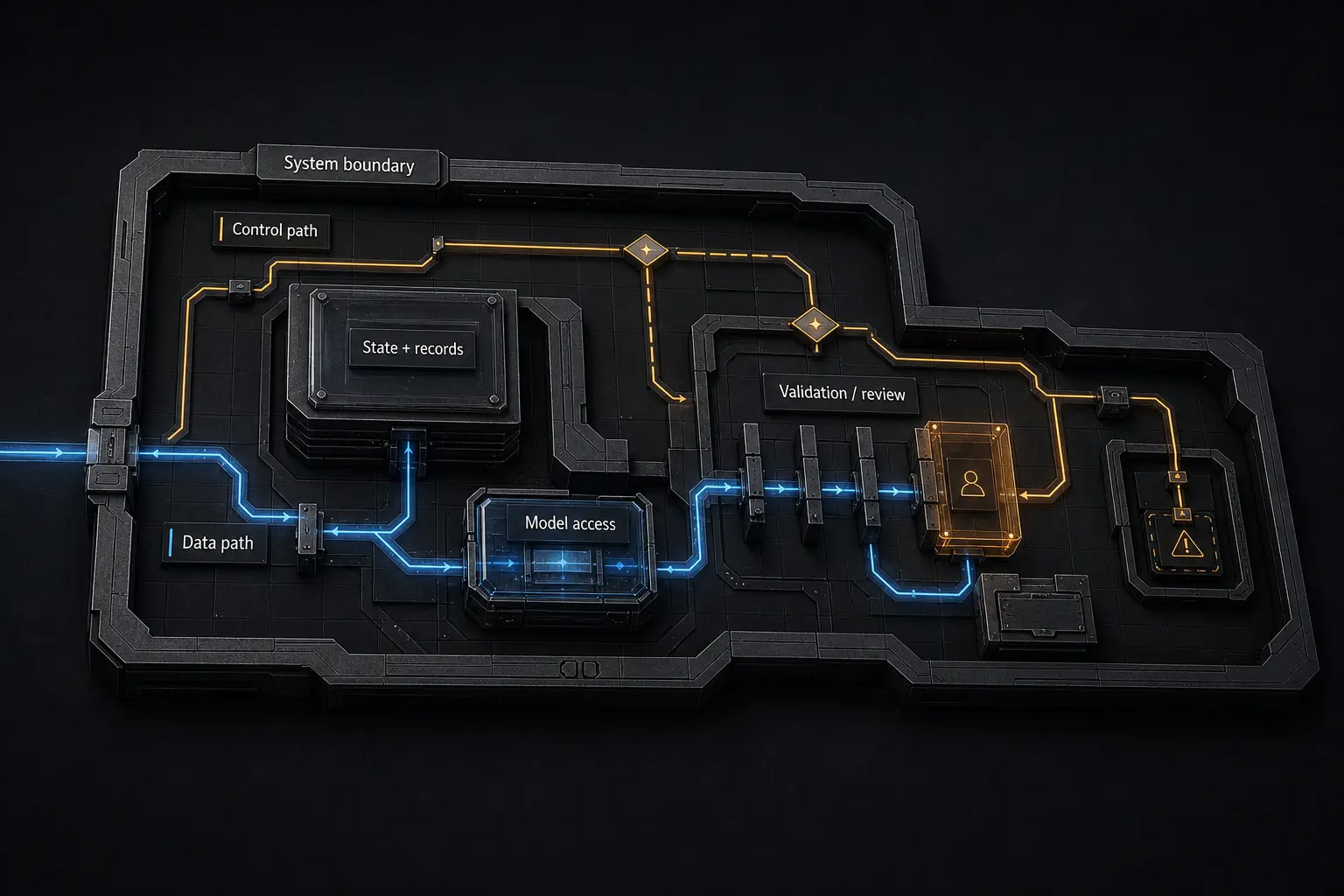
AI system architecture surrounds a model with deterministic software, data systems, integrations, controls, and human decision points. A model can interpret language or generate useful output, but it does not independently provide reliable data access, enforce business rules, manage permissions, validate decisions, or recover from failures. Those responsibilities belong to the wider application.
The practical challenge is deciding which components are necessary, where state lives, how information moves, what the model may decide, and how failures become visible and recoverable. A useful design needs explicit boundaries, component responsibilities, data and control flows, production safeguards, and a controlled implementation sequence.
Table of Contents
- What AI System Architecture Actually Includes
- Define the System Boundaries Before Choosing Components
- A Reference Architecture for Production AI Applications
- Assign Each Decision to the Right Layer
- Design for Validation, Observability, and Failure
- Build and Evolve the Architecture in Controlled Stages
- FAQ
- What to Do Next?
What AI System Architecture Actually Includes
AI system architecture describes how models, application logic, interfaces, data stores, integrations, operational controls, and human processes work together to produce and govern an AI-enabled outcome. It differs from model architecture: transformer layers, attention mechanisms, training methods, and parameters concern the model itself. AI application architecture concerns how an application uses that model.
A production system may include an interface or trigger, authentication, orchestration, model access, databases, retrieval, APIs, deterministic business logic, structured output handling, validation, observability, and human oversight. This is a set of possible responsibilities, not a mandatory stack. A bounded classification tool may need only a few of them. A system that accesses private records and proposes consequential actions needs stronger controls.
It helps to separate two connected paths. The data path moves inputs, retrieved context, model outputs, validation results, and stored records. The control path determines whether a request is authorized, which step runs next, whether an output is accepted, and whether an action requires approval. The model may inform the control path, but it should not silently own permissions or business-critical transitions.
A prototype might send a support question directly to an LLM and display the answer. A production support-drafting system authenticates the user, retrieves authorized records, assembles constrained context, requests structured output, validates required fields, records the result, and routes sensitive cases to a reviewer. The model call may be similar. The surrounding responsibilities make the second system operable.
Production readiness is not merely better output in a demonstration. It requires repeatability, visibility, recoverability, security boundaries, maintainable interfaces, and known ownership. A useful answer that cannot be traced, corrected, or safely withheld is not yet a dependable production capability.
Define the System Boundaries Before Choosing Components
Good AI architecture design begins with an operational outcome, not a model or framework. Identify who or what triggers the system, what input arrives, what output is required, and what follows that output. Drafting, recommending, classifying, updating a record, and initiating an external action are materially different responsibilities.
Define the system boundary by listing external dependencies, source-of-truth systems, downstream destinations, and accountable owners. Inventory inputs by format, freshness, reliability, sensitivity, and access requirements. A user-supplied paragraph, uploaded contract, and authorized database record may all become model context, but they have different trust levels and handling obligations.
The output also needs a contract. Free text may suit a draft intended for review. Downstream automation usually requires structured data with named fields, allowed values, and explicit missing-data behavior. A classification needs a defined label set. A recommendation should distinguish evidence from proposed action. An executable instruction requires stricter authorization than any of these.
AI systems design must cover operational requirements as well as functional behavior: latency, volume, cost boundaries, access control, audit needs, versioning, retries, and manual recovery. There are no universal thresholds. The limits must be explicit enough to shape the architecture.
For an incoming-document workflow, a concise map might show file upload, extraction, document-type checking, retrieval of related records, a structured model summary, deterministic field validation, and an exception queue. This exposes boundaries before technology is selected: Which system owns the records? What happens if extraction is incomplete? Which documents may the model access? Who resolves an unknown type?
Mark risk and uncertainty at each transition. An awkward draft may be inconvenient and reversible. A wrong classification that changes access, payment, or compliance status carries greater consequences. The two outputs should not share an automation policy merely because the same model can generate them.
A Reference Architecture for Production AI Applications
A practical production flow is: interface or trigger, authentication and input checks, orchestration, context retrieval, model call, output parsing and validation, business action or human review, then storage and monitoring. This is a logical LLM system architecture, not a prescribed product stack. Several responsibilities may initially live in one application if their boundaries remain clear.
The interface receives a request from a person, webhook, scheduled job, or upstream application. Authentication establishes identity; authorization determines which records and actions that identity may access. Input checks reject unsupported formats, missing identifiers, excessive payloads, and other known invalid states before a model call occurs.
Orchestration coordinates the sequence, passes data between steps, applies branching rules, records state, and handles exceptions. Coordination is not automatically intelligence. A workflow that always retrieves a record, calls a model, validates the response, and requests approval is better described as orchestration than as an agent.
A model-access layer can provide a stable boundary for prompts, model selection, timeouts, retries, structured responses, and usage records. It is especially useful when workflows share model access or provider-specific behavior must be isolated. A small application may not need a separate service, but it should still keep provider response formats out of core business logic.
Retrieval also requires clear boundaries. An operational database holds authoritative records and workflow state. A search or vector index supports discovery; it is not automatically the source of truth. Retrieval may include query formation, permission-aware filtering, candidate selection, source lookup, context assembly, and evidence references. Similarity search is only one option. Direct database queries or conventional search may fit better when records are structured.
Structured outputs create an interface between probabilistic generation and deterministic processing. A schema can require fields, types, and allowed values, making parsing and branching more reliable. Schema conformance does not prove factual correctness. A valid object can still contain an unsupported claim or omit critical evidence.
Consider a decision-support brief. An authenticated request enters the application, authorized records are retrieved, and context is assembled with source identifiers. The model returns a defined schema. Deterministic checks verify completeness and allowed values; evidence checks confirm support for required claims. Uncertain cases enter review, while the final status and trace metadata are stored.
Queues and workers are useful when tasks are long-running, bursty, or need independent retries. They should answer a real workload requirement. Human-review queues also require deliberate design: reviewers need source context, the model proposal, validation results, defined decisions, and a clear route back into the workflow. Observability should follow the request through every stage, not only the model call.
Assign Each Decision to the Right Layer
The central architectural judgment is decision ownership. Use deterministic logic for rules that can be expressed reliably. Use models for interpretation, extraction, classification, or generation where ambiguity exists and probabilistic behavior is acceptable. Use people where accountability, consequence, or unresolved uncertainty requires human judgment.
Four criteria make this assignment concrete: predictability, consequence, reversibility, and rule clarity. A predictable decision with clear rules belongs in code. An ambiguous language task with a reversible outcome may suit a model. A consequential, hard-to-reverse action usually requires an approval boundary, even when a model supplies the recommendation.
- Deterministic software should own permissions, calculations, required-field checks, known routing rules, and enforceable business constraints.
- Models can interpret unstructured inputs, propose classifications, extract meaning, generate drafts, and rank options where variation is acceptable.
- Agents fit tasks that genuinely require runtime tool selection or multi-step adaptation.
- People should own decisions whose accountability or material consequences cannot be delegated safely.
Retrieval can provide governed external context, but authorization and record ownership remain outside the model. A model may request information through a controlled tool; it should not decide that a user deserves access because the request sounds legitimate. Permission to draft an update is not permission to write it into the source system.
Agentic behavior should be bounded by permitted tools, action limits, durable state, stopping conditions, approval gates, and recovery paths. If the sequence is already known, a fixed workflow is usually safer, cheaper, easier to test, and easier to debug. A model-controlled planner adds another failure surface without necessarily improving the result.
For example, a trusted category code can support deterministic routing. Ambiguous language may justify an LLM-proposed category. If routing triggers an irreversible external action, a person or strict policy gate should approve it. An open-ended agent adds little value because the steps and boundaries are already understood.
Human review is not a universal safety mechanism. Reviewers need relevant context, clear acceptance criteria, sufficient time, and meaningful decision options. A queue that displays only the model answer invites rubber-stamping. Production AI architecture should treat review as an operational component, not a vague fallback.
Design for Validation, Observability, and Failure
Validation should be layered because each check answers a different question. Input validation determines whether a request is usable. Retrieval validation checks whether required sources were found and authorized. Schema validation checks shape and types. Business-rule validation enforces known constraints. Evidence and policy checks assess support and permitted content. Human review handles cases that remain uncertain or consequential.
No guardrail guarantees correctness. Output validation can detect malformed, incomplete, or disallowed results, but semantic accuracy requires comparison with evidence, expected behavior, or human judgment. Valid JSON is not necessarily a trustworthy decision.
Suppose a model returns syntactically valid JSON but omits a business-critical fact because the required source record was unavailable. Schema validation passes. An evidence check detects the missing record, records an insufficient-evidence state, blocks the downstream action, and sends the case for review. Retrying the same request blindly would reproduce the missing-context problem.
Useful observability connects events across the workflow. Records may include request and trace identifiers, step status, latency, model and prompt version, retrieval metadata, validation outcomes, tool calls, review decisions, and terminal state. Logging needs privacy boundaries: prompts, credentials, personal data, and sensitive records should not be retained indiscriminately for debugging.
Failure states should be explicit outcomes. Common categories include retryable dependency error, invalid output, insufficient evidence, denied permission, exhausted budget, review required, and permanent failure. Each needs a defined response. A temporary API failure may justify a bounded retry with backoff. A permission denial should not.
Retries also require idempotency and duplicate prevention. If a workflow times out after performing an external action, repeating it could perform that action twice. The system needs to know which steps completed, assign stable operation identifiers, and make repeated requests safe where possible. Dead-letter or manual-recovery paths are appropriate when automated recovery cannot resolve the state.
System-health monitoring and model-quality evaluation are related but separate. Monitoring asks whether requests complete, dependencies respond, and failure rates change. Evaluation asks whether outputs remain useful, grounded, and policy-compliant across representative cases. A workflow can be operationally healthy while producing poor recommendations, or produce good average outputs while often failing to complete.
Prompt, model, retrieval, schema, and business-rule changes should be versioned and evaluated. Silent degradation is more dangerous than visible failure because it can continue unnoticed. Dependable production AI architecture makes changes, failure reasons, and terminal states inspectable, with clear ownership for remediation.
Build and Evolve the Architecture in Controlled Stages
Begin with one bounded workflow, a known input, a defined output contract, and an accountable owner. Establish a baseline with a direct model call, representative cases, expected failure categories, and manual review. This tests whether the model is suitable before infrastructure obscures its basic behavior.
Add complexity only in response to demonstrated requirements. Introduce retrieval when governed external knowledge is necessary, persistent state when a process spans steps or sessions, and queues when workload requires asynchronous execution or independent retries. Use agentic control only when runtime choices cannot be represented adequately through deterministic branches.
Clear interfaces keep components replaceable. Prompts and provider-specific response formats should not be embedded throughout business logic. Centralized configuration can version prompts, schemas, model choices, retrieval settings, and validation rules. Component tests verify parsers, permissions, routing, and integrations; end-to-end tests verify the complete data and control paths.
A document-classification workflow might begin with human-reviewed model classifications. Add structured outputs and deterministic checks once the label contract is stable, then connect an approved record source when governed context is needed. Asynchronous workers become justified only when workload or processing time requires them. Automate low-risk downstream actions after the failure modes and recovery paths are understood.
Deployment controls should match consequence. Staged release, sampled review, and rollback paths allow changes to be evaluated without assuming every improvement is safe. Reviewer feedback and operational failures are architecture inputs, not merely prompt-editing signals. Repeated missing evidence may require a retrieval change; duplicate actions indicate a state problem; confusing reviews may expose a poor approval interface.
Revisit AI architecture design when scale, risk, integration count, or ownership changes. A production-readiness review should cover boundaries, input and output contracts, permissions, state, validation, failure handling, observability, ownership, and maintenance. Architectural maturity is not the number of components. It is the degree to which each necessary responsibility is explicit, controlled, and supportable.
FAQ
What is the difference between AI system architecture and model architecture?
Model architecture concerns a model’s internal structure and training design. System architecture concerns how the model is integrated with software, data, interfaces, controls, and operations to deliver an application outcome. Teams can design production systems without building or modifying the underlying model.
Does every AI system need RAG or a vector database?
No. Retrieval-augmented generation is useful when a task needs external, current, private, or governed knowledge. Direct database queries, conventional search APIs, supplied context, or no retrieval may be more appropriate. A vector database is one retrieval mechanism, not a default requirement.
When should an architecture use an AI agent instead of a fixed workflow?
Use an agent when the task requires meaningful runtime choices among tools or steps that deterministic branching cannot represent adequately. Define its permitted tools, state, stopping conditions, observability, recovery paths, and approval gates. If the steps are known, a fixed workflow is usually easier to control and test.
How should an AI application manage state and memory?
Separate workflow state, conversation history, user preferences, retrieved context, and durable records. Process status and authoritative facts should live in controlled data stores rather than implicit model memory. Retention, access, and update rules should follow the use case and its privacy requirements.
How do you test a production AI system when model outputs vary?
Combine deterministic unit and integration tests with schema and policy checks, representative evaluation cases, end-to-end workflow tests, failure injection, and human review of qualitative behavior. Test acceptable ranges, evidence use, decision boundaries, and failure handling rather than expecting identical wording on every run.
What to Do Next?
Choose one concrete AI-enabled workflow and create a one-page system map. Identify its trigger, inputs, source-of-truth data, required output, downstream action, and accountable owner. Draw the data path separately from the control path, then label each decision as deterministic, model-assisted, agentic, or human-owned.
- Specify one input contract and one output contract.
- Define where state persists and how access is controlled.
- List the three most important failure states and their recovery paths.
- Set the validation and human-review boundaries.
- Test normal, ambiguous, and failure cases end to end.
- Remove any component that does not serve a stated requirement.
Review the design against consequence, reversibility, privacy, maintainability, and operational ownership before expanding the technology stack. The smallest architecture that makes responsibilities, uncertainty, and recovery explicit is usually the strongest place to begin.