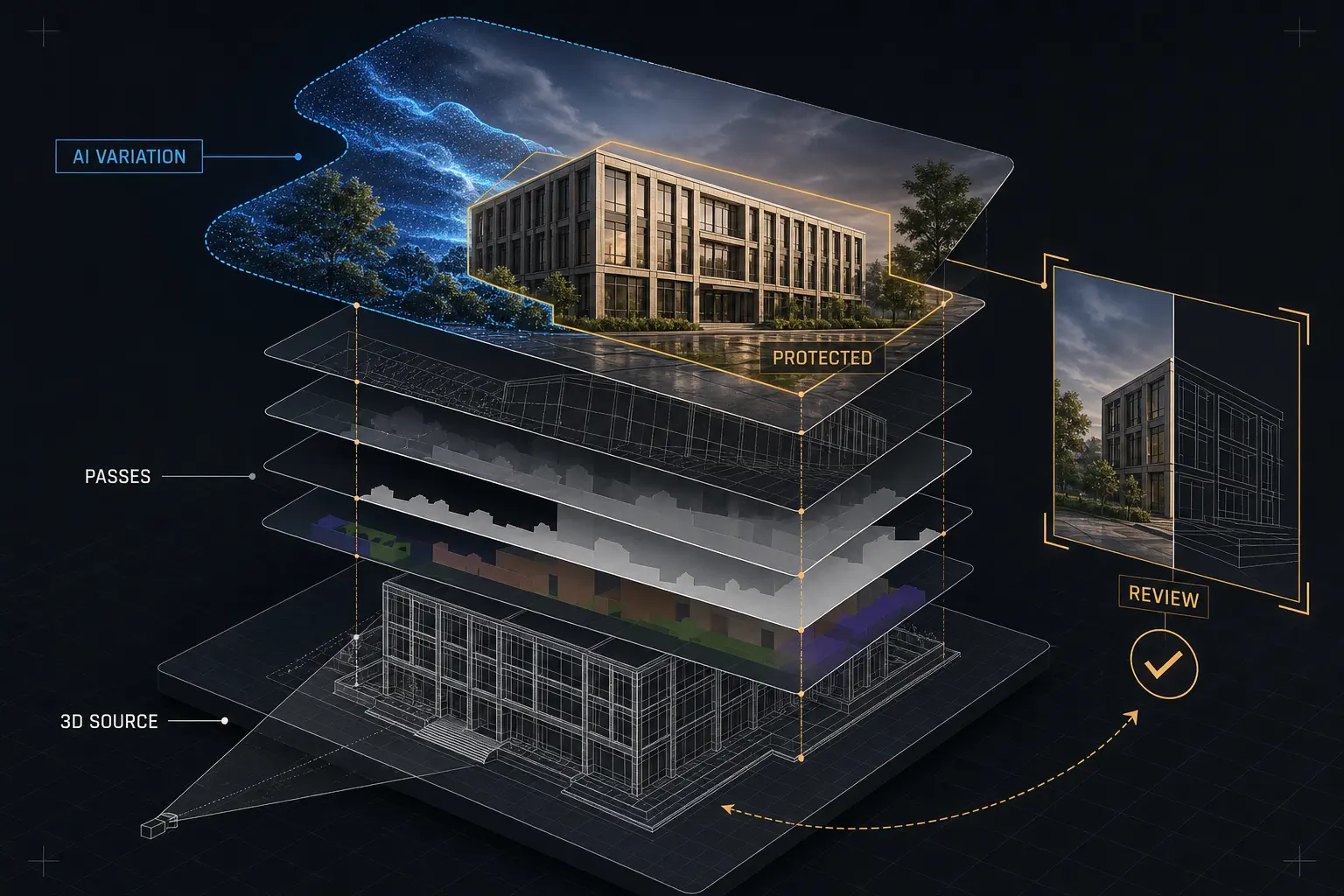
A reliable ai archviz workflow combines a controlled 3D foundation with selective generative transformation, compositing, validation, and human approval. The 3D scene preserves geometry, camera logic, scale, materials, and repeatable revisions; AI contributes where variation or interpretation is useful. An attractive generated image is not necessarily an accurate representation of the architecture.
The production challenge is deciding which stages require deterministic control, which image attributes AI may change, what can be automated safely, and where review must remain explicit. A workable pipeline needs more than prompts and render settings. It needs defined inputs, protected information, version relationships, failure handling, and approval gates that can withstand design feedback.
Table of Contents
- What Makes an AI Archviz Workflow Production-Ready?
- Assigning Responsibilities Across the Visualization Pipeline
- The Core Stages of an AI Archviz Workflow
- Controlled Generation and Compositing
- Validation and Human Review
- Automation, Reliability, and Scaling
- FAQ
- What to Do Next?
What Makes an AI Archviz Workflow Production-Ready?
An AI archviz workflow is production-ready when it operates as a controlled sequence of inputs, transformations, checks, revisions, and approved outputs. It must do more than produce a successful frame once. It should preserve critical design information, make changes traceable, support feedback, and allow the team to recover when a generated result fails.
In most hybrid pipelines, the 3D scene remains the source of truth. It controls massing, dimensions, camera position, object placement, material assignments, lighting structure, and the spatial relationships that must remain stable across revisions. Render passes can also provide masks, depth, normals, material selections, and object boundaries for downstream transformations and reconstruction.
Generative AI belongs around that controlled foundation rather than automatically replacing it. It can support atmosphere studies, planting variations, selected styling details, minor entourage, surface character, or AI-assisted post-production. The useful boundary depends on the deliverable. A concept image can tolerate broader interpretation than a planning view or a marketing image tied to an approved façade package.
This exposes an important distinction: visual plausibility is not architectural correctness. An isolated AI-generated exterior may look convincing while quietly changing window spacing, slab thickness, access routes, balcony depth, or material joints. Those errors become consequential when the image must retain approved massing, façade rhythm, camera, materials, and landscape intent through multiple revisions.
A dependable AI architectural visualization workflow therefore needs four qualities:
- Control over the information that must not change.
- Consistency across versions, views, and related deliverables.
- Traceability from the final image back to its scene, render, generated candidates, and composite.
- Recoverability when a generation, handoff, or revision produces an unacceptable result.
Not every exploratory image requires this degree of governance. Production readiness matters when design fidelity, repeatability, stakeholder review, or consistency across an image set matters.
Assigning Responsibilities Across the Visualization Pipeline
A strong hybrid pipeline does not ask one tool to solve every visual problem. It assigns responsibilities according to the kind of control each stage provides. Conventional 3D is strong where spatial precision and repeatability matter. Generative AI is useful where bounded variation is acceptable. Compositing reconciles the two, while human judgment determines whether the result communicates the design correctly.
Conventional 3D rendering should usually own geometry, cameras, object placement, lighting structure, and key material relationships. It also produces supporting information that a beauty render alone cannot provide: object IDs, material masks, depth, normals, alpha channels, and other passes appropriate to the pipeline. These outputs make it possible to isolate changes and reconstruct details without regenerating the entire image.
Generative AI archviz is most useful when given a specific task. It might explore restrained interior styling, propose atmospheric variations, enrich a selected landscape region, or create candidates for secondary details. It is less dependable when asked to preserve every architectural relationship while broadly reinterpreting the full frame. References and structural guidance can reduce drift, but they do not turn probabilistic generation into deterministic rendering.
Architectural visualization automation has a different role. It can prepare folders, enforce naming rules, submit renders, collect passes, apply presets, route files, generate contact sheets, record status, and check explicit requirements. These operations follow defined rules. They should not be confused with generation, and neither automation nor generation is equivalent to approval.
Compositing integrates accepted elements while restoring the image’s internal logic. Generated vegetation still needs believable occlusion. A modified finish must respond consistently to light and reflection. Entourage must sit at the correct depth and scale. Architectural edges, contact shadows, material transitions, and visual hierarchy often need deliberate reconstruction rather than a simple overlay.
Consider an interior view. The 3D scene fixes the room dimensions, openings, circulation, camera, and primary furniture layout. Render passes preserve depth and object boundaries. AI explores limited styling or atmospheric alternatives. Compositing integrates only approved changes. Human review then checks furniture scale, ceiling continuity, reflections, material behavior, and whether the circulation route still reads correctly. That division of responsibility makes AI assisted architectural visualization controllable.
The Core Stages of an AI Archviz Workflow
The core stages of an ai archviz workflow move from design control to bounded transformation and then back to a validated production output. The exact passes and controls vary by deliverable, but the dependency order matters: define what is true before asking AI to reinterpret any part of it.
- Brief and control definition: identify approved design information, required views, camera constraints, fidelity level, mood, and areas open to interpretation.
- 3D scene preparation: organize geometry, cameras, materials, lights, object IDs, and scene versions so repeatable reference outputs can be produced.
- Baseline rendering: create an architecturally valid base image and the masks, depth data, normals, or material selections required by the planned transformations.
- AI task selection: define the region, attribute, or visual problem that generation is allowed to modify.
- Generation and selection: produce constrained candidates, compare them with the baseline, and reject options that alter protected information.
- Compositing and reconstruction: integrate accepted elements, repair transitions, restore deterministic details, and reconcile light, depth, color, and material behavior.
- Validation and review: perform architectural, visual, technical, and brief-compliance checks before approval.
- Output and version capture: retain the source scene, baseline render, selected candidate, composite version, approval state, and final output relationship.
For an exterior dusk image, the process might begin with an approved daylight camera and a baseline render whose façade geometry is already correct. The AI task is then limited to the sky, atmospheric softness, and selected foreground character. Candidate skies are assessed against the intended light direction. Approved elements are composited while the original façade, glazing divisions, and hardscape remain anchored to the render.
Validation compares the composite with the baseline, checking silhouette, openings, material boundaries, landscape intent, and camera consistency. The final capture records which scene and render produced the image. If the façade later changes, the team can rerender the controlled source and rebuild only the affected transformations instead of reverse-engineering an untraceable generated frame.
This makes the AI rendering pipeline revision-aware. A low-risk mood study may use fewer passes and a lighter review process. A high-fidelity image exposed to repeated design changes needs stronger scene organization, protected-region checks, and version capture. More control is useful only where the deliverable justifies it.
Controlled Generation and Compositing
Controlled generation starts by dividing image information into two categories: protected and changeable. Protected information commonly includes major geometry, openings, façade rhythm, camera, horizon, perspective, circulation, fixed elements, key materials, and approved design features. Changeable information might include atmosphere, planting character, minor entourage, subtle surface variation, or styling details that the brief deliberately leaves open.
This boundary should be defined before generation, not inferred after an appealing result appears. For a façade image, window spacing, mullion alignment, balcony depth, slab edges, and camera perspective may be protected. Planting density and atmospheric softness may be changeable. If a generated candidate improves the landscape but distorts the façade, the appropriate response is selective extraction, not acceptance of the complete frame.
Regional transformation generally carries less design risk than full-image generation. Masks, segmentation, depth cues, edge references, and pass-informed inputs can help constrain the operation where appropriate. They are controls, not guarantees. Thin railings, repeating mullions, reflected geometry, partial occlusions, and material joints remain vulnerable to drift even when the broad composition survives.
Generated alternatives should therefore be treated as candidates. Selection asks more than whether an option looks realistic. Does it preserve the protected information? Does the new detail agree with the scale and lighting? Does it strengthen the intended focal hierarchy, or merely add texture everywhere? Apparent detail can make an image busier while weakening architectural communication.
Selective compositing is where AI assisted architectural visualization becomes a directed image-making process. Accepted regions are integrated while hard edges, contact shadows, reflections, and depth relationships are rebuilt as needed. A generated tree must sit correctly behind one element and in front of another. Softened atmosphere should reduce distant contrast without washing out the primary elevation. A modified material needs continuity across corners and plausible behavior in reflections.
The goal is not to hide that AI was used. It is to produce an image whose architecture, spatial logic, material behavior, and visual direction remain coherent.
Validation and Human Review
Validation in an AI architectural visualization workflow should be divided into four dimensions. Architectural checks cover massing, proportions, openings, alignments, circulation, fixed elements, and approved features. Visual checks cover composition, lighting direction, material continuity, reflections, depth, scale cues, repeated artifacts, anatomy, entourage, edge quality, and occlusion.
Technical checks address output dimensions, color handling, file naming, missing passes, version relationships, masks, compression, and unintended resampling. Brief-compliance checks can confirm the required view, mood, season, occupancy, design emphasis, and permitted scope of interpretation. An image can pass three categories and still fail the fourth.
For example, an AI archviz interior variation may create convincing atmosphere while changing the ceiling geometry, replacing a coordinated chair family with inconsistent designs, and removing a required doorway. Review can preserve the atmospheric treatment, reject the spatial alterations, restore protected details from deterministic passes, and validate the reconstructed image again.
Useful review gates occur before expensive downstream work:
- Approve the baseline composition and architecture before generation.
- Approve a generated candidate before detailed compositing.
- Approve the final composite only after all four validation categories have been checked.
Side-by-side comparisons, overlays, and protected-region checks are more reliable than memory. They make subtle movement in openings, rooflines, furniture, or horizon position easier to detect. Automated checks can flag missing files, incorrect dimensions, broken version relationships, or unexpected changes in protected regions. They cannot decide whether the composition communicates the design or whether a visual alteration is acceptable.
Human review is therefore a decision stage, not a ceremonial glance at the end. The reviewer must be able to accept, reject, reconstruct, or return an image to an earlier stage with a clear reason.
Automation, Reliability, and Scaling
Automate stable, repetitive operations before ambiguous creative decisions. Good candidates include folder creation, naming, metadata capture, render submission, pass collection, format conversion, file routing, status notifications, contact-sheet generation, and checklist enforcement. Subjective selection, design interpretation, composition judgment, and final approval should remain explicit human responsibilities.
Each automated stage needs a clear contract: accepted inputs, required metadata, expected outputs, version identifiers, and completion conditions. Validation should occur before the next handoff. Missing passes, incorrect dimensions, duplicate version labels, or failed generation outputs should stop or divert the process rather than silently enter the composite.
Retries also need boundaries. A temporary technical failure may justify a retry. An invalid source file, contradictory instruction, or consistently unacceptable creative result requires correction or rejection, not an endless loop. Logging should make it possible to trace the source render, settings, generated candidate, composite version, and approval state behind any delivered output.
There are three sensible operating modes:
- A manual hybrid workflow suits uncertain, experimental, or low-volume tasks where the boundaries are still being learned.
- A template-based workflow suits recurring deliverables with known passes, folder structures, transformation regions, and review requirements.
- An orchestrated AI rendering pipeline suits repeatable work whose inputs, exception paths, validation rules, and approval states are stable enough to formalize.
A recurring view set, for example, might use architectural visualization automation to collect approved passes, verify dimensions and naming, prepare generation inputs, and assemble review sheets. AI candidates still require visual selection, and a composite cannot advance without an explicit approval state.
Greater orchestration does not inherently improve image quality. It becomes worthwhile when it reduces preventable handoff errors, preserves traceability, and supports revisions without obscuring responsibility. Scaling means reliable repetition and recovery, not merely producing more images.
FAQ
Where should AI enter an architectural visualization pipeline?
AI should enter at a defined task boundary after the workflow establishes what must remain controlled. It may support broad mood exploration early or selective post-production later. The appropriate entry point depends on design fidelity, revision exposure, deliverable type, and how much interpretation the brief permits.
Can generative AI preserve architectural geometry accurately?
Structural references, masks, depth information, and other controls can reduce geometric drift, but they are not guarantees. Geometry, camera position, and approved design information should remain anchored to the 3D source and be verified after each generative transformation.
When is full-image generation appropriate in AI archviz?
Full-image generation is more appropriate for exploratory mood development, early concept imagery, or deliverables that permit broad interpretation. Later-stage views requiring stable façades, cameras, materials, or consistency across multiple images generally benefit from regional transformation and selective compositing.
What should be automated in an AI archviz workflow?
Start with repetitive operations that have objectively testable outcomes, such as naming, file routing, render-pass collection, dimension checks, metadata capture, review-sheet assembly, and version recording. Creative selection, architectural interpretation, and final approval require visual judgment.
How do you maintain consistency across multiple AI-assisted views?
Use shared 3D assets, fixed cameras, consistent material references, documented protected features, and deliberate rules about what may vary. Review views together rather than independently. Separate generations should never be assumed to preserve geometry, materials, entourage, or atmospheric logic automatically.
What to Do Next?
Choose one real visualization deliverable rather than redesigning the entire pipeline. Map its current process on one page, identify the 3D source of truth, and label protected and changeable information. Separate deterministic rendering tasks, generative tasks, compositing work, and human decisions, then define the input and expected output for each stage.
Run one controlled test with review gates after the baseline render, AI selection, and final composite. Record failures and decide whether each needs prevention, automated detection, regeneration, manual correction, or rejection. Then test the workflow against a revision request. Its value is revealed by fidelity, repeatability, review effort, traceability, and recoverability—not by the first final-looking image.