AI architectural rendering can accelerate selected parts of visualization production, but it should not be treated as an equally reliable controller of geometry, cameras, materials, or design intent. Generative tools are effective when variation is useful. A conventional 3D scene remains more dependable when an architectural decision must survive multiple views, revisions, and formal approval. Faster image creation and reliable production output are not the same goal.
The practical challenge is deciding where those boundaries belong: what must remain fixed, what may vary, which references the AI receives, and how every generated contribution will be checked. A controlled approach uses AI around an authoritative architectural source rather than asking it to reconstruct the entire image. That requires suitable intervention points, non-destructive production steps, explicit quality criteria, and a clear way to decide whether the apparent speed gain survives correction and review.
Table of Contents
- AI Architectural Rendering as Controlled Augmentation
- Separate Fixed Controls From Generative Choices
- Where AI Can Accelerate Rendering Production
- Build a Controlled AI Rendering Workflow
- Quality Control for AI-Assisted Rendering
- Choose the Right Production Mode
- FAQ
- What to Do Next?
AI Architectural Rendering as Controlled Augmentation
In production terms, AI architectural rendering means using generative image tools within or alongside an established visualization pipeline. It does not have to mean replacing modeling, scene assembly, lighting, rendering, and compositing with a single generated frame. AI-assisted rendering is often strongest as an additional image-making layer: useful for exploration, localized enhancement, and controlled variation while the architectural foundation remains intact.
A 3D scene encodes explicit relationships. The camera has a defined position and field of view. Openings belong to walls, façade modules follow a rhythm, materials have deliberate assignments, and lights occupy known locations. If the design changes, those relationships can be revised and rendered again. The scene may still contain mistakes, but it provides an inspectable, repeatable source for producing coordinated images.
Generative AI rendering works differently. It produces probabilistic image variations from its inputs and constraints, so it may reinterpret information that appears settled. A façade can look convincing while its window spacing has changed. A material transition can appear polished while no longer matching the specification. Visual plausibility is not the same as architectural correctness.
The useful principle is simple: retain explicit scene control wherever a requirement must survive revisions, appear consistently in several views, or pass an approval check. Permit generative variation where alternatives have value and exact continuity is less important. AI architectural visualization becomes safer when that distinction is made before generation rather than after an attractive result has influenced the review.
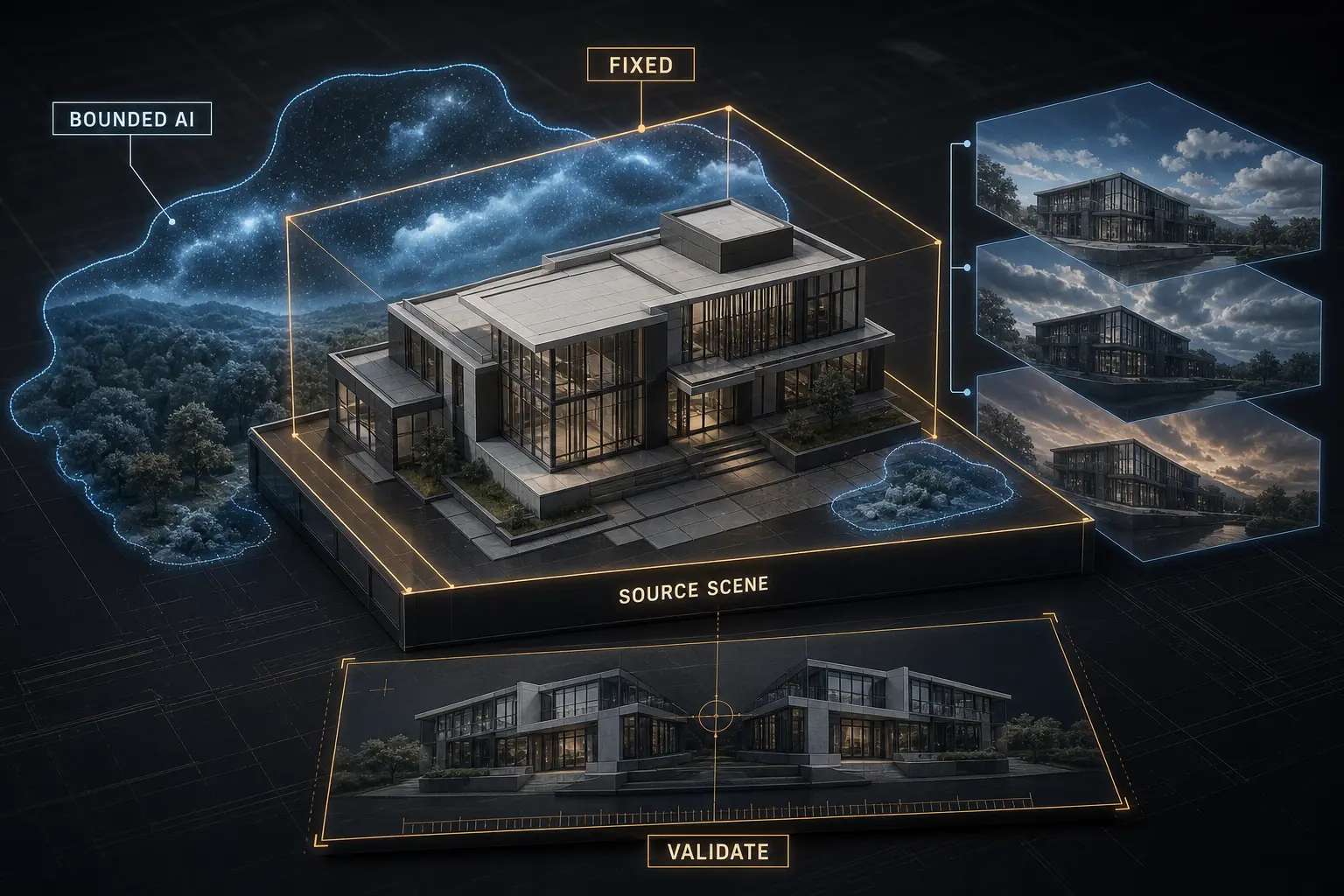
Consider an approved exterior base render. A controlled use might explore warmer atmosphere, enrich a distant landscape, or develop a bounded sky treatment while protecting the building and restoring it from the base where necessary. Regenerating the whole frame for the same purpose creates a wider risk: altered mullions, softened slab edges, invented façade details, or inconsistent material transitions. Both methods can produce attractive images, but only one begins by respecting what has already been approved.
Separate Fixed Controls From Generative Choices
Before selecting an AI method, divide the image into three categories: fixed controls, bounded variables, and open exploration. This is more useful than asking whether AI should be used on the image as a whole. Different parts of the frame carry different levels of architectural significance, revision sensitivity, and tolerance for variation.
- Fixed controls include the approved camera, lens or field of view, massing, openings, structural relationships, façade rhythm, critical material assignments, building silhouette, and primary composition.
- Bounded variables can include atmosphere, distant context, vegetation density, minor entourage, surface weathering, or selected post-production effects when the deliverable allows interpretation.
- Open exploration includes early mood studies, broad stylistic directions, seasonal options, and alternative visual narratives before architectural commitments are presented as resolved.
The categories depend on the image’s purpose. An internal mood study can tolerate more ambiguity than a marketing image based on an approved model. A documentation-adjacent presentation may require strict material and geometry fidelity. Even landscaping can shift categories: generic distant planting may be flexible, while a designed landscape plan with specified species, spacing, and sightlines should be protected.
Prompts express intent, but they do not enforce architectural constraints as scene geometry does. Masks, base images, object and material selections, depth information, references, region-based editing, render passes, and compositing can narrow the area in which generation operates. They improve control without guaranteeing preservation. The result still requires direct comparison with the architectural source.
For an exterior hero view with an approved façade and camera, the protected set might include perspective, silhouette, openings, fins, entrances, roof edges, and primary materials. The variable set might include sky, distant trees, selected people, and atmospheric depth. Generated elements can then be composited around the architecture rather than allowed to rewrite it. This creates a controlled architectural rendering AI workflow with a defined change boundary.
The most important preparation is not prompt writing. It is identifying the image facts that cannot move. Once those facts are explicit, the production team can choose inputs and masks that support the boundary, then reject any output that crosses it.
Where AI Can Accelerate Rendering Production
AI creates the clearest production advantage where alternatives are desirable and expensive scene changes are not yet justified. During early visual exploration, generative AI rendering can help test atmosphere, season, time of day, landscape mood, or broad post-production direction from a stable composition. These images can guide look development without being mistaken for resolved architectural decisions.
Generated references can also help define a target. A team might explore the softness of overcast light, the density of planting, the character of a weathered surface, or the balance between interior warmth and exterior coolness. The reference should remain directional. If it invents construction details or physically implausible lighting, those inventions do not become valid merely because the overall mood is persuasive.
Later in production, AI-assisted rendering is better suited to bounded tasks. Possible uses include developing a distant background, adding restrained atmospheric layers, varying non-critical vegetation, supporting local cleanup, enriching selected texture detail, or testing entourage options. The smaller and less design-sensitive the affected region, the easier it is to compare, composite, revise, or discard.
Option studies can also benefit when they begin from the same base render and document what may change. Ten broad atmosphere directions derived from one stable image may reveal a useful visual route quickly. By contrast, independently regenerating ten final views after a façade revision creates a consistency problem. The updated façade is better resolved once in the source scene and propagated through the coordinated cameras.
Production speed should be measured beyond the first output. The real cost can include preparing inputs, generating alternatives, selecting a result, correcting defects, compositing, validating the design, responding to review, and revising later. An image produced quickly can still be expensive if its architecture must be repaired manually or if the treatment cannot be repeated across the image set.
Higher-risk uses include resolving unfinished architecture through generation, reproducing exact branded products, changing specified materials, producing required views independently, or regenerating an approved frame to handle one minor revision. These tasks demand precision or repeatability. An impressive first frame offers little production value if the next requested change cannot be made predictably.
Build a Controlled AI Rendering Workflow
A reliable AI rendering workflow starts with the deliverable, not the generator. Define the image’s purpose, visual objective, required accuracy, likely revision pattern, and approval conditions. A concept study and a final hero image may use similar tools, but they typically should not have the same tolerance for architectural drift.
Next, list the fixed and variable elements. Prepare a stable source scene containing the approved camera, resolved geometry, intentional composition, and dependable material assignments. This scene remains the source of truth. AI output is a branch derived from it, not a replacement for it.
Produce a base render and the supporting information available in the existing pipeline. Depending on the task, useful outputs may include object masks, material selections, depth information, or separate render passes. These assets help isolate architecture, preserve edges, control compositing, and compare generated regions against known scene information.
Then choose the smallest useful AI task. If the objective is to improve the view beyond a window, do not regenerate the room. If the objective is atmospheric depth, protect the façade rather than asking the model to reproduce it. Supply appropriate references and constraints, but treat them as guidance rather than proof that the result will adhere exactly.
Generate alternatives in a non-destructive branch. Keep source assets, generated options, selected outputs, and final composites separate and clearly versioned. Selection should be based on the stated visual objective and architectural fidelity, not novelty. A restrained output that integrates cleanly is often more useful than a dramatic one that changes the image’s visual hierarchy.
Composite accepted regions back into the controlled base. This allows the 3D render to retain ownership of critical geometry, materials, lighting relationships, and camera logic. Validate the composite at working and final presentation scales, record accepted decisions, and retain a clear route back to the source scene for revisions.
An interior offers a practical example. The approved camera, room geometry, built-in joinery, furniture scale, and major materials remain rendered from the scene. AI is tested only on a masked exterior view through the glazing and a restrained atmospheric treatment. During compositing, review the window edges, reflections, color spill, depth, and whether the generated exterior reads at the correct scale. The inserted view cannot be judged in isolation.
Failure recovery should be planned rather than improvised. If generation repeatedly alters protected content, reduce the affected region. If that fails, strengthen the reference, composite a smaller accepted fragment, correct the issue conventionally, return to the 3D scene, or reject the generated output. Removing AI from a task can be a valid production decision when correction costs exceed its contribution.
Quality Control for AI-Assisted Rendering
Quality control must test architectural fidelity as well as surface polish. Generated-image drift is often difficult to notice because the replacement detail looks plausible. The safest review method is direct comparison with the controlled base and relevant design references, not judgment from memory.
- Geometry: compare silhouettes, floor lines, openings, mullions, joints, stairs, railings, façade modules, furniture proportions, and repeated elements.
- Camera and composition: check perspective, horizon, verticals, crop, focal hierarchy, foreground relationships, and depth cues.
- Materials: verify assignments, transitions, reflectivity, color relationships, texture scale, and continuity across connected surfaces.
- Lighting: inspect shadow direction, source logic, reflections, contact shadows, and the balance between interior and exterior illumination.
- Design intent: identify additions, omissions, changed dimensions, softened details, invented landscaping, and altered spatial relationships.
- Image quality: look for duplicated objects, malformed people, contaminated edges, inconsistent sharpness, texture artifacts, and local style changes.
Set consistency requires a separate pass. An enhancement that works in one frame may introduce a different season, material character, planting density, or atmosphere from the remaining views. Repeated architectural elements must also retain the same design. Multi-view inconsistency is especially likely when each frame is generated independently rather than derived from one coordinated source scene.
Every issue should lead to an explicit response: accept it, composite locally, correct it manually, regenerate within a smaller boundary, return to the source scene, or reject it. For example, a polished exterior may change the spacing of façade fins and introduce a plausible door. Those are design changes, not minor artifacts. The correct response is to restore the approved regions rather than rationalize the generated variation.
Review the final composite at its intended output scale. Enlargement, sharpening, and compression can reveal edge contamination, local texture problems, malformed entourage, or geometry changes that were less visible during selection. A technically clean AI architectural visualization can still communicate the wrong design, so artifact removal cannot substitute for architectural review.
Choose the Right Production Mode
The appropriate production mode depends on risk, not enthusiasm for a particular method. Evaluate six factors: design fidelity, repeatability, revision frequency, value of variation, traceability, and correction cost. The higher the cost of an unintended architectural change, the stronger the case for keeping that content under scene-based control.
Conventional-first rendering suits exact, coordinated, and revision-heavy deliverables. It is the safer mode when the same decisions must appear across multiple views or animations, when materials are specified, or when geometry will continue changing. AI can still support peripheral tasks, but it does not own the architectural foundation.
Bounded AI-assisted rendering suits controlled enhancements around a trusted base. It works when a task benefits from visual interpretation but can be isolated, compared, and composited without altering critical design information. This is often the most practical middle ground because it combines scene control with selective generative flexibility.
AI-heavy exploration suits early concepts where variation is the objective and architectural commitments remain limited. It can help compare broad moods or visual narratives before detailed production. These images still need careful labeling and review; invented design elements can create false expectations if viewers read them as approved architecture.
Consider three hypothetical deliverables. An early mood study can use AI-heavy exploration because variation has high value and precision is not yet the main objective. A single marketing image based on an approved model may be better served by bounded AI assistance around a controlled render. A coordinated set of revision-heavy views may remain conventional-first because geometry fidelity, repeatability, and revision propagation often dominate the decision.
A project can move between modes. Early studies may be generative, while approved final production often becomes increasingly controlled. The durable rule is to choose the least variable method capable of achieving the visual objective. Architectural rendering AI should be judged by approved-delivery speed, including correction and revisions, rather than the speed at which its first appealing image appears.
FAQ
Can AI architectural rendering preserve exact geometry?
Masks, base images, localized processing, and other controlled inputs can improve adherence, but generative output should not be assumed to preserve geometry exactly. Design-critical forms should remain authoritative in the 3D scene, with generated output compared directly against the base before acceptance.
Does AI-assisted rendering replace a rendering engine?
It can support or bypass parts of conventional rendering during exploration, but a rendering engine remains valuable for stable cameras, explicit lighting, defined materials, repeatable geometry, coordinated views, and predictable revisions. The two methods can occupy different layers of the same workflow.
How can AI renderings stay consistent across multiple views?
Derive the views from the same source scene, retain stable lighting and material decisions, reuse approved visual references, and limit full-frame regeneration. Compare each generated treatment with the complete image set. Consistency becomes harder when every view is generated independently.
When should AI enter the rendering workflow?
AI may enter early for mood exploration, after the base render for bounded enhancement, or during post-production for localized changes. The right point depends on the task, but fixed design decisions and permitted variation should be defined before generation begins.
Which architectural images need the most cautious AI use?
Use greater caution for images with strict design fidelity, specified products or materials, repeated façade systems, technical scrutiny, multiple coordinated views, or frequent revisions. These conditions can increase the cost of probabilistic changes and favor conventional or tightly bounded methods.
What to Do Next?
Start with one stable base render and one bounded production problem. Mark the camera, geometry, materials, composition, lighting relationships, and design details that must not change. Then identify one region where controlled variation could provide useful exploration or reduce production work without rewriting the architecture.
- Preserve the source scene and original render.
- Mark protected and variable regions.
- Write a short fidelity checklist for geometry, camera, materials, lighting, composition, and design intent.
- Test one localized AI intervention and composite it into the base.
- Compare the result at final presentation scale and define how it would be revised.
- Record whether the complete cycle reduced work while preserving the required controls.
Expand AI use only when the test creates a repeatable production advantage. One attractive output is evidence of visual potential, not proof of a dependable workflow.